Today's
EarthStation1.com 15% Off Commemorative Memorial Title: Crazy
Movie Trailers 1960s-1970s MP3 Set DVD, Download, USB Drive
Today, November 19, 2025
November 19: National Carbonated Beverage
With Caffeine Day: -- A unique beverage holidays that give us
opportunities to break out of our everyday norms and explore the
variety of carbonated beverages with caffeine. Some people cannot
have caffeine due to medical reasons, and others choose to avoid
caffeine as a personal choice. Then there are the millions of
people who reach for the caffeine every morning and sometimes all
day long. The same applies to carbonated beverages. Today's
celebration combines the two of them. In 1767, Englishman Joseph
Priestly suspended a bowl of distilled water above a beer vat at a
local brewery in Leeds, England. His experiment led to a method of
infusing water with carbon dioxide to make carbonated water.
Priestly's invention of carbonated water is the major and defining
component of most soft drinks. Caffeine acts as a central nervous
system stimulant, temporarily warding off drowsiness and restoring
alertness. Ninety percent of adults in North America consume
caffeine daily. Some people notice sleep disruption after drinking
beverages containing caffeine, though others see no appreciable
disturbance. Other terms for carbonated beverages include
sparkling, bubbly, or effervescent. Almost any beverage can be
carbonated, though not every beverage should be carbonated. Sodas
are the most common caffeinated, carbonated drinks, but some
makers can add some fizz to cold-brewed coffee these days. In
addition, certain sparkling waters infuse flavors and add caffeine
for that extra boost. To observe Carbonated Beverage With Caffeine
Day: Enjoy your favorite carbonated and caffeinated beverage! Pour
it over ice for a cold and invigorating refreshment. Invite
someone to join you and toast the day. Are you looking for some
ways to mix up your carbonated beverage with caffeine? Wine and
soda together are nothing new. It's a spritzer. Only this time,
you're adding a caffeinated soda to the ice, wine, and garnish;
Ice cream soda is a classic cold beverage, and it comes
caffeinated. So you get the caffeine and brain freeze all in one.
What more could you want?; There is a whole lineup of rum and cola
drinks. Any one of them is bound to hit the spot and use
#CarbonatedBeverageWithCaffeineDay to post on social media! On
Sale @ 15% Off Discount Till Midnight PT!
https://store.earthstation1.com/crazy-movie-trailers-1960s1970s-coming-attraction196019703.html
Today's
EarthStation1.com 15% Off Commemorative Memorial Title: Scouts!
Lord Baden-Powell The Boy Scouts & The Girl Scouts MP4 DVD USB
Today, November 19, 2025
November 19: National Camp Day: -- Grab
your hot dogs and marshmallows! According to a survey by the ACA
Youth Outcomes Battery, 96% of campers make new friends at camp
and 70% gain self-confidence during a camp experience. Whether it
was summer camp or a family trip, we have lots of wilderness
memories. Recreational camping can be traced back to Briton Thomas
Hiram Holding, but it was popularized in the UK on the river
Thames. In the 1880s large numbers of visitors took part in
camping, which related to the late-Victorian craze for pleasure
boating. Early camping equipment was heavy, so it was more
convenient to transport it by boat or transportation craft that
could be converted into a tent. Though Holding is seen as the
father of camping, he's responsible for popularizing a different
form of camping in the UK. In his youth, he experienced activity
in the wild and spent time in the American prairies with his
parents. He later embarked on a cycling and camping tour across
Ireland with some friends. His book, "Cycle and Camp in
Connemara," led to the formation of the first camping group
in 1901, the Association of Cycle Campers - which later became the
Camping and Caravanning Club. In 1908 Holding wrote "The
Campers Handbook " so that he could share his enthusiasm for
the outdoors with the rest of the world. In the 1870s and 1880s
the first summer camps promised boys a chance to escape the
indoors and fast-paced urban life. Girls camps started to appear
in the U.S. around 1900, many of which were located around New
England. The oldest and continuously run camp for girls is Camp
Wyonegonic in Maine, which opened in 1902. In 1900, there were
less than 100 summer camps in the U.S., but by 1918 over 1,000
were in operation. On Sale @ 15% Off Discount Till Midnight PT!
https://store.earthstation1.com/scouts-the-life-and-legacy-of-lord-badenpowell-dvd-mp4-us4.html
Today's
EarthStation1.com 15% Off Commemorative Memorial Title: Mrs.
Fenwick Went To Washington: Millicent Fenwick DVD, Download, USB
Today, November 19, 2025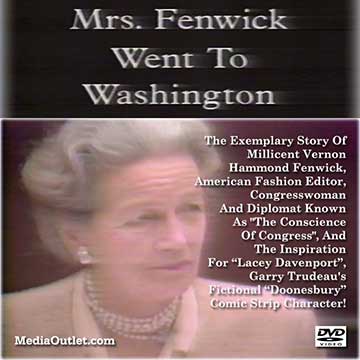
November 19: Women's Entrepreneurship
Day: -- Honors female entrepreneurs and to discuss their
contributions to the entrepreneurial community. Did you know that
the first female-owned business in the U.S. was established in
1739? Despite the advances made by women entrepreneurs since the
Industrial Revolution, gender barriers, societal pressure, access
to funding and mentorship, and lack of education still constrain
their growth. Women's Entrepreneurship Day is organized by the
WEDO (Women's Entrepreneurship Day Organization) and recognized by
the United Nations and over 120 countries. On Women's
Entrepreneurship Day, pioneering women in various fields are given
the WEDO Pioneer Awards. Women have been involved in
entrepreneurial ventures for centuries, but they were not
considered entrepreneurs because the term was exclusive to men.
During the 18th and 19th centuries, most businesses owned by women
were either from inheritance or supplemented personal income.
Eliza Lucas Pinckney of South Carolina was one woman who became a
business leader through inheritance. She took over her family's
plantations when she was 16 years old, becoming the first female
recorded to own a business in the U.S. Women began owning
brothels, alehouses, taverns, and retail shops around the same
time. However, because of the societal perception of what a woman
should and should not do, these businesses were considered
shameful. In the 1900s, public perception shifted toward the
progressive, and feminism became a widely accepted movement. This
allowed people to refer to women in business as female
entrepreneurs. Black women became the most enterprising women in
the U.S. during the early 20th Century. They established
themselves in dressmaking, Black hair care, private home domestic
work, and midwifery. Madam C. J. Walker, the first African
American female millionaire, was one of the most successful women
of this era. Various organizations launched in the United States
were founded in the late 1980s and 1990s to provide education and
financing to female entrepreneurs. Among these are the Women's
Business Development Center and Count Me In. But none of this was
enough to put women entrepreneurs on an equal footing with their
male counterparts. Since 2000, there has been an increase in
support and attention for female entrepreneurs, and female-owned
businesses now have more access to financing than ever before.
After returning to the U.S. in 2013 from volunteering with the
Adelante Foundation in Honduras, Wendy Diamond started an
initiative to empower women in business. This initiative became
the Women's Entrepreneurship Day Organization (WEDO). On November
19, 2014, WEDO celebrated the first Women's Entrepreneurship Day
in the U.S. and over 140 countries. Since then, New York City and
Los Angeles have declared it an official day, the U.S. House of
Representatives has recognized it, and the United Nations
celebrated it. On Sale @ 15% Off Discount Till Midnight PT!
https://store.earthstation1.com/mrs-fenwick-went-to-washington-dvd-millicent-fenwick.html
Today's
EarthStation1.com 15% Off Commemorative Memorial Title: Last
Images Of War Journalists Of The Soviet-Afghan War DVD, MP4, USB
Today, November 19, 2025
November 19: International Journalist
Day: -- Today we celebrate and honor the memories of those
journalists who laid down their lives while performing their
duties. Journalists serve as the eyes and ears of the public. They
are responsible for providing us with the necessary information we
need. It is therefore important to have a day to recognize their
efforts. All over the world, journalists face threats to their
lives. Some are purposely targeted and murdered because of their
work while some are killed in incidents such as bomb explosions.
Many governments around the world target journalists for
harassment, intimidation, and violence as they cover political
stories. Journalism dates back to the Han dynasty in China, which
made use of regularly published news bulletins. But it was not
until the 17th Century that publications reporting the news to the
general public in a standardized fashion began to appear.
Mass-printing technologies like the printing press were developed
and allowed for the establishment of newspapers to provide
increasingly literate audiences with the news. The first records
of privately-owned newspaper publishers in China date back to the
late Ming dynasty in 1582. In Europe, the first newspaper is often
recognized as Johann Carolus's "Relation aller Furnemmen und
gedenckwurdigen Historien," published in 1605 in Strasbourg.
In some regions such as the Roman Empire and the British Empire,
journalistic enterprises were started as private ventures. Other
countries such as France and Prussia tightly controlled the press,
treating it principally as an outlet for government propaganda and
subjecting it to consistent censorship. Other governments such as
the Russian Empire were even warier of journalists. They
effectively outlawed journalistic publications until the mid-19th
Century. As newspaper publications became a more established
practice over time, publishers increased publication to a weekly
or daily rate. Centers of trade such as London, Amsterdam, and
Berlin had a heavier concentration of newspapers. Latin America
established its first newspapers in the mid- to late 19th Century.
Today, people increasingly consume news digitally through
e-readers, smartphones, and other electronic devices. This has led
to the decline of traditional media and the reduction of staff in
newsrooms. The digital era has also introduced citizen journalism
thanks to the internet. On Sale @ 15% Off Discount Till Midnight
PT!
https://store.earthstation1.com/last-images-of-war-journalists-sovietafghan-war-dvd-mp4-usb-driv4.html
Today's
EarthStation1.com 15% Off Commemorative Memorial Title: Columbus &
The Age Of Discovery TV Series + Bonus MP4 Download DVD Set
Today, November 19, 2025
November 19: Discovery Of Puerto Rico
Day: -- November 19, 1493: European explorer Christopher Columbus
goes ashore on an island he first saw the day before called
Borinquen by the Taino people native to the island. He names it
San Juan Bautista (later renamed again Puerto Rico). Discovery of
Puerto Rico Day commemorates this eventful occasion, a day is
marked as a public holiday on the island. Banks, schools, and
public offices are closed on this day, and a grand parade is
organized in every major city, and many buildings are adorned with
the country's flag and nationalist memorabilia to honor the
nation's sovereignty and its indigenous roots, which can still be
seen to this day. The day also signals the arrival of the holy
month of December, and Puerto Ricans put up their decorations
right after the holiday. Christopher Columbus was a man of
conviction who believed - before anyone else - that there existed
other ways, new paths yet to be discovered. In an age when people
thought that everything had already been found, Columbus, an
ardent student of geography and science, rowed his ship towards
the unknown. His four infamous voyages unveiled the West. After
the controversial results of his first adventure, he embarked on
his second trip on September 24, 1493, with over 1200 soldiers
sprawled on 17 ships. Nearly two months later, he anchored in a
bay near an island on November 19, 1943, which he later named San
Juan Bautista. Almost all American countries have dedicated a day
to point out the inception of their nation through Columbus.
Discovery of Puerto Rico Day honors the journey of the explorer
and acknowledges the indigenous culture, dialect, and traditions
of the land at the same time. The nation has recognized Columbus
on numerous occasions. Their Spanish heritage was honored in 1893,
on the 400th anniversary of his landfall, with a stamp that
depicted his figure on a ship with a crew in the background. On
Sale @ 15% Off Discount Till Midnight PT!
https://store.earthstation1.com/columbus-and-the-age-of-discovery-epic-7-hourlong-episode-tv-serie7.html
Today's
EarthStation1.com 15% Off Commemorative Memorial Title: Monarchy
In The UK: British Royal History MP4 Video Download DVD Set
Today, November 19, 2025
November 19, 1600: #BOTD: #HBD! Charles
I, King Of Scotland, England And Ireland, who maintained the
Divine Right of kings to rule and opposed the Parliament Of
England's challenges to his authoritarian style(d. January 30,
1649) is #born Charles Stuart in Dunfermline Palace, Fife,
Scotland into The House Of Stuart (originally spelt Stewart) as
the second son of King James VI of Scotland, but after his father
inherited the English throne in 1603 (as James I), he moved to
England, where he spent much of the rest of his life. He ruled
from 1625 to 1649. He maintained the Divine Right of kings to rule
and opposed the Parliament Of England's challenges to his
authoritarian style. This resulted in the English Civil War
(1642-1651) and his eventual execution, followed by the
establishment of The Commonwealth Of England with Oliver Cromwell
as Lord Protector. He became heir apparent to the three kingdoms
of England, Scotland, and Ireland in 1612 on the death of his
elder brother Henry Frederick, Prince Of Wales. An unsuccessful
and unpopular attempt to marry him to the Spanish Habsburg
princess Maria Anna culminated in an eight-month visit to Spain in
1623 that demonstrated the futility of the marriage negotiations.
Two years later he married the Bourbon princess Henrietta Maria of
France. After his succession in 1625, Charles quarrelled with the
Parliament of England, which sought to curb his royal prerogative.
Charles believed in the divine right of kings, and was determined
to govern according to his own conscience. Many of his subjects
opposed his policies, in particular the levying of taxes without
parliamentary consent, and perceived his actions as those of a
tyrannical absolute monarch. His religious policies, coupled with
his marriage to a Roman Catholic, generated antipathy and mistrust
from Reformed religious groups such as the English Puritans and
Scottish Covenanters, who thought his views were too Catholic. He
supported high church Anglican ecclesiastics such as Richard
Montagu and William Laud, and failed to aid continental Protestant
forces successfully during the Thirty Years' War. His attempts to
force the Church of Scotland to adopt high Anglican practices led
to the Bishops' Wars, strengthened the position of the English and
Scottish parliaments, and helped precipitate his own downfall.
From 1642, Charles fought the armies of the English and Scottish
parliaments in the English Civil War. After his defeat in 1645, he
surrendered to a Scottish force that eventually handed him over to
the English Parliament. Charles refused to accept his captors'
demands for a constitutional monarchy, and temporarily escaped
captivity in November 1647. Re-imprisoned on the Isle of Wight,
Charles forged an alliance with Scotland, but by the end of 1648
Oliver Cromwell's New Model Army had consolidated its control over
England. Charles I died when he is beheaded in front of Whitehall
Palace in London, ten days after Charles was found guilty of high
treason and condemned as "a tyrant, traitor, murderer, and
public enemy" in the treason trial that the Rump Parliament
voted for at the conclusion of the English Civil War. He is buried
in the same burial vault in the quire as Henry VIII and Jane
Seymour, after the decision to bury him in Edward IV's vault was
changed. He had been brought before a high court of justice at
Westminster Hall on January 20, 1649. The monarchy was then
abolished and the Commonwealth of England was established as a
republic. This resulted in the English Civil War (1642-1651). The
Civil War had been fought over whether the King's power was
absolute, or was limited by the powers of Parliament. Oliver
Cromwell had led the Parliamentary forces to victory over the
Royals. The monarchy would be restored to Charles's son, Charles
II, in 1660. #CharlesI #CharlesIOfEngland #KingOfEngland
#KingOfScotland #KingOfIreland #MonarchyOfTheUnitedKingdom
#BritishMonarchy #BritishNobility #BritishHistory
#RoyalPrerogative #DivineRightOfKings #AbsoluteMonarch
#EnglishCivilWar #CommonwealthOfEngland #BritishMonarchy
#BritishNobility #HouseOfStuart #MP4 #VideoDownload #DVD On Sale @
15% Off Discount Till Midnight PT!
https://store.earthstation1.com/monarchy-in-the-uk-british-royal-history-mp4-video-download-dvd-set.html
Today's
EarthStation1.com 15% Off Commemorative Memorial Title: The
Western Tradition TV Series DVD, MP4 Video Download, USB Drive
Today, November 19, 2025
November 19, 1703: France: The History Of
France: Governments Of France: The French Monarchy: The Monarchy
Of The Kingdom Of France: Punitive Masks: The History Of Punitive
Masks: The Man In The Iron Mask (French: L'Homme Au Masque De
Fer): -- #DOTD: #RIP: The unidentified French prisoner of state
during the reign of King Louis XIV Of France (1643-1715), who came
to be known as The Man In The Iron Mask (though he actually wore a
velvet mask) (Birthdate Unknown, c. 1658) #dies on a Monday in The
Bastille prison in Paris, and was buried the next day in the
nearby cemetery of Saint-Paul. The Bastille's record of his death
notes that he was known as "M. de Marchiel". The parish
burial register of Saint-Paul records his name as "Marchioly"
(possibly Marchialy), leading several historians to conclude the
prisoner was Italian diplomat Ercole Antonio Mattioli, and states
that he was 45 years old. Nothing more is known. Warranted for
arrest on July 19, 1669 under the pseudonym of "Eustache
Dauger", he was apprehended near Calais on July 28,
incarcerated on August 24, and held for 34 years in the custody of
the same jailer, Benigne Dauvergne de Saint-Mars, in four
successive French prisons, including the Bastille. The strict
measures taken to keep his imprisonment secret resulted in a
long-lasting legend about his identity. Even though it has been
extensively debated by historians, his true identity remains a
mystery, and various theories have been expounded in numerous
books, articles, poems, plays, and films. During his lifetime, it
was rumoured that he was a Marshal Of France or a President Of
Parlement; The Duke Of Beaufort, or a son of Oliver Cromwell.
Among the oldest theories is one proposed by French philosopher
and writer Voltaire, who claimed in his Questions sur
l'Encyclopedie (1771) that the prisoner was an older, illegitimate
brother of Louis XIV. More than 50 candidates, real and imaginary,
have been proposed by historians and other authors aiming to solve
the mystery. What little is known about the prisoner is based on
contemporary documents that surfaced during the 19th century,
mainly some of the correspondence between Saint-Mars and his
superiors in Paris, initially Louvois, Louis XIV's secretary of
state for war. These documents show that the prisoner was labelled
"only a valet" and that he was jailed for "what he
was employed to do" before his arrest. Legend has it that no
one ever saw his face, as it was hidden by a mask of black velvet
cloth, later misreported by Voltaire as an iron mask. Official
documents reveal, however, that the prisoner was made to cover his
face only when travelling between prisons after 1687, or when
going to prayers within the Bastille in the final years of his
incarceration; modern historians believe the latter measure was
imposed by Saint-Mars solely to increase his own prestige, thus
causing persistent rumours to circulate about this seemingly
important prisoner. He has been the subject of many works of
fiction, most prominently in 1850 by Alexandre Dumas. A section of
his novel The Vicomte of Bragelonne: Ten Years Later -- the final
installment of his D'Artagnan saga -- features this prisoner,
portrayed as Louis XIV's identical twin and forced to wear an iron
mask. In 1840, Dumas had first presented a review of the popular
theories about the prisoner extant in his time in the chapter
"L'Homme Au Masque De Fer", published in the eighth
volume of his non-fiction Crimes Celebres. This approach was
adopted by many subsequent authors, and speculative works have
continued to appear on the subject. On Sale @ 15% Off Discount
Till Midnight PT!
https://store.earthstation1.com/the-western-tradition-dvd-set-all-52-shows-13-d5213.html
Today's
EarthStation1.com 15% Off Commemorative Memorial Title: The
American Adventure: TV History Series 1607-1876 DVD MP4 USB Drive
Today, November 19, 2025
November 19, 1794: The Age Of
Enlightenment (The Enlightenment, The Age Of Reason): The Age Of
Revolution: The Atlantic Revolutions: The American Enlightenment:
The American Revolution: The American Revolutionary War: The
Aftermath Of The American Revolution: The Presidency Of George
Washington: United Kingdom - United States Treaties: The Jay
Treaty (The Treaty Of Amity, Commerce, And Navigation, Between His
Britannic Majesty And The United States Of America; The Jay
Treaty, Jay's Treaty): -- The United States and The Kingdom Of
Great Britain sign Jay's Treaty in an attempt to avert war and
resolve issues remaining since the Treaty Of Paris of 1783 which
ended the American Revolutionary War. The Jay Treaty facilitated
ten years of peaceful trade between the United States and Britain
in the midst of the French Revolutionary Wars, which began in
1792. The Treaty was designed by Alexander Hamilton and supported
by President George Washington. It angered France and bitterly
divided Americans. It inflamed the new growth of two opposing
parties in every state, the pro-Treaty Federalists and the
anti-Treaty Jeffersonian Republicans. The Treaty was negotiated by
John Jay and gained many of the primary American goals. This
included the withdrawal of British Army units from forts in the
Northwest Territory that it had refused to relinquish under the
Paris Peace Treaty. The British were retaliating for the United
States reneging on Articles 4 and 6 of the 1783 treaty; American
state courts impeded the collection of debts owed British
creditors and upheld the continued confiscation of Loyalist
estates in spite of an explicit understanding that the
prosecutions would be immediately discontinued. The parties agreed
that disputes over wartime debts and the American-Canadian
boundary were to be sent to arbitration-one of the first major
uses of arbitration in modern diplomatic history. This set a
precedent used by other nations. The Americans were granted
limited rights to trade with British colonies in the Caribbean in
exchange for some limits on the American export of cotton. The Jay
treaty was signed on November 19, 1794, during the Thermidorian
Reaction in France, and submitted to the United States Senate for
its advice and consent the following June. It was ratified by the
Senate on June 24, 1795, by a two-thirds majority vote of 20-10
(exactly the minimum number necessary for concurrence). It was
also ratified by the British government, and took effect February
29, 1796, the day when ratifications were officially exchanged.
The treaty was hotly contested by Jeffersonians in each state. An
effort was made to block it in the House, which ultimately failed.
The Jeffersonians feared that closer economic or political ties
with Great Britain would strengthen Hamilton's Federalist Party,
promote aristocracy, and undercut republicanism. This debate
crystallized the emerging partisan divisions and shaped the new
"First Party System", with the Federalists favoring the
British and the Jeffersonian republicans favoring France. The
treaty was for ten years' duration. Efforts failed to agree on a
replacement treaty in 1806 when Jefferson rejected the
Monroe-Pinkney Treaty, as tensions escalated toward the War of
1812. On Sale @ 15% Off Discount Till Midnight PT!
https://store.earthstation1.com/the-american-adventure-series-us-1st-century-4-dv14.html
Today's
EarthStation1.com 15% Off Commemorative Memorial Title: The Old
Time Radio History MP3 MegaSet DVD, Audio Download, USB Drive
Today, November 19, 2025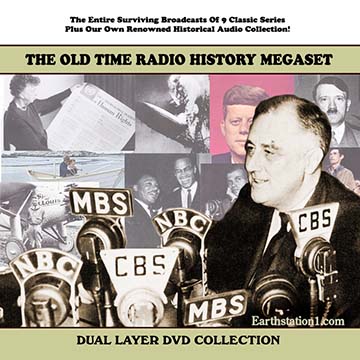
November 19, 1862: #BOTD: #HBD! Billy
Sunday, American radio televangelist and athlete who, after being
a popular outfielder in baseball's National League during the
1880s, became the most celebrated and influential American
evangelist during the first two decades of the 20th century (d.
November 6, 1935) is #born in poverty as William Ashley Sunday
near Ames, Iowa. His father, William Sunday, was the son of German
immigrants named Sonntag, who had anglicized their name to
"Sunday" when they settled in Chambersburg,
Pennsylvania. William Sunday was a bricklayer who worked his way
to Iowa, where he married Mary Jane Corey, daughter of "Squire"
Martin Corey, a local farmer, miller, blacksmith, and wheelwright.
William Sunday enlisted in the Iowa Twenty-Third Volunteer
Infantry on August 14, 1862. He died four months later of
pneumonia at an army camp in Patterson, Missouri, five weeks after
the birth of his youngest son, William Ashley. Mary Jane Sunday
and her children moved in with her parents for a few years, and
young Billy became close to his grandparents and especially his
grandmother. Mary Jane Sunday later remarried, but her second
husband soon deserted the family. When Billy Sunday was ten years
old, his impoverished mother sent him and an older brother to the
Soldiers' Orphans Home in Glenwood, Iowa, and later to the Iowa
Soldiers' Orphans' Home in Davenport, Iowa. At the orphanage,
Sunday gained orderly habits, a decent primary education, and the
realization that he was a good athlete. Sunday spent some years at
the Iowa Soldiers' Orphans' Home before working at odd jobs and
playing for local running and baseball teams. His speed and
agility provided him the opportunity to play baseball in the major
leagues for eight years, where he was an average hitter and a good
fielder known for his base-running. Converting to evangelical
Christianity in the 1880s, Sunday left baseball for the Christian
ministry. He gradually developed his skills as a pulpit evangelist
in the Midwest and then, during the early 20th century, he became
the nation's most famous evangelist with his colloquial sermons
and frenetic delivery. Sunday held widely reported campaigns in
America's largest cities, and he attracted the largest crowds of
any evangelist before the advent of electronic sound systems. He
also made a great deal of money and was welcomed into the homes of
the wealthy and influential. Sunday was a strong supporter of
Prohibition, and his preaching likely played a significant role in
the adoption of the Eighteenth Amendment in 1919. Despite
questions about his income, particularly those regarding big
business financing of his prohibition crusades, no scandal ever
touched Sunday. He was sincerely devoted to his wife, who also
managed his campaigns, but his three sons disappointed him,
engaging in many of the activities he preached against, and the
Sundays paid blackmail to several women to keep the scandals
relatively quiet. In 1930, Nora Lynn, their housekeeper and nanny,
who had become a virtual member of the family, died. Then the
Sundays' daughter, the only child actually raised by his wife
Helen Thompson "Nell" Sunday, died in 1932 of what seems
to have been multiple sclerosis. Their oldest son George, rescued
from financial ruin by his parents, committed suicide in 1933.
Nevertheless, even as the crowds declined during the last 15 years
of his life, Sunday continued accepting preaching invitations and
speaking with effect. In early 1935, he had a mild heart attack,
and his doctor advised him to stay out of the pulpit. Sunday
ignored the advice. He died on November 6, a week after preaching
his last sermon on the text "What must I do to be saved?"
His audiences grew smaller during the 1920s as Sunday grew older,
religious revivals became less popular, and alternative sources of
entertainment appeared such as radio and motion pictures.
Accordingly, Billy Sunday went on to pioneer radio preaching, and
did that so enthusiastically that the FCC was formed when his
radio signal began overlapping ballgame broadcasts. Sunday
continued to preach and remained a stalwart defender of
conservative Christianity until his death. On Sale @ 15% Off
Discount Till Midnight PT!
https://store.earthstation1.com/the-old-time-radio-history-megaset-dual-layer-mp3-dv3.html
Today's
EarthStation1.com 15% Off Commemorative Memorial Title:
Gettysburg: A Video Civil War History DVD, Video Dowload, USB
Drive
Today, November 19, 2025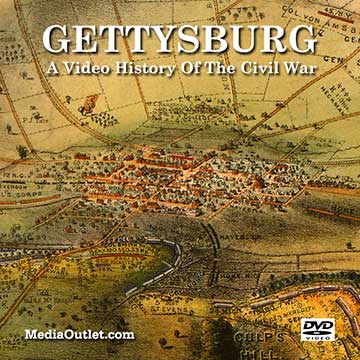
November 19, 1863: The American Civil War
(The Civil War, The War Between The States): The Eastern Theater
Of The American Civil War: The Gettysburg Campaign: The Battle Of
Gettysburg: The Gettysburg Address: -- President Abraham Lincoln
delivers the Gettysburg Address during afternoon ceremonies
dedicating 17 acres of the Gettysburg Battlefield as the Soldiers'
National Cemetery, four and a half months after the Union armies
defeated those of the Confederacy at the Battle Of Gettysburg. It
is one of the best-known speeches in both American and world
history. Famed orator Edward Everett of Massachusetts preceded
Lincoln and spoke for two hours. Not even the day's primary
speech, Lincoln then delivered his address in under two minutes.
Although many in attendance were at first unimpressed, Lincoln's
words have come to symbolize the definition of democracy itself,
and so impressed Edward Everett that the declared that the
President had more clearly come to the point of his speech in two
minutes than Everett himself had in two hours. Lincoln's carefully
crafted address came to be seen as one of the greatest and most
influential statements of American national purpose. In just 271
words, beginning with the now iconic phrase "Four score and
seven years ago", referring to the signing of the Declaration
Of Independence 87 years earlier, Lincoln described the US as a
nation "conceived in Liberty, and dedicated to the
proposition that all men are created equal", and represented
the Civil War as a test that would determine whether such a
nation, the Union sundered by the secession crisis, could endure.
He extolled the sacrifices of those who died at Gettysburg in
defense of those principles, and exhorted his listeners to resolve
"that these dead shall not have died in vain - that this
nation, under God, shall have a new birth of freedom-and that
government of the people, by the people, for the people, shall not
perish from the earth." Despite the prominent place of the
speech in the history and popular culture of the United States,
its exact wording is disputed. The five known manuscripts of the
Gettysburg Address in Lincoln's hand differ in a number of
details, and also differ from contemporary newspaper reprints of
the speech. Neither is it clear where the platform stood from
which Lincoln delivered the address. Modern scholarship locates
the speakers' platform 40 yards (or more) away from the
traditional site in Soldiers' National Cemetery at the Soldiers'
National Monument, such that it stood entirely within the private,
adjacent Evergreen Cemetery. On Sale @ 15% Off Discount Till
Midnight PT!
https://store.earthstation1.com/gettysburg-a-video-history-of-the-civil-war-dvd.html
Today's
EarthStation1.com 15% Off Commemorative Memorial Title: A 78 RPM
Christmas Song MP3 MegaSet CD, Audio Download, USB Stick
Today, November 19, 2025
November 19, 1905: #BOTD: #HBD! Tommy Dorsey, American jazz trombonist, composer, conductor and bandleader of the big band era, known as The "Sentimental Gentleman Of Swing" because of his smooth-toned trombone playing (d. November 26, 1956) is #born Thomas Francis Dorsey Jr. in Mahanoy Plane, Pennsylvania, the second of four children born to Thomas Francis Dorsey Sr., himself a bandleader, and Theresa (nee Langton) Dorsey. He and Jimmy, his older brother by slightly less than two years, became famous as the Dorsey Brothers. His theme song was "I'm Getting Sentimental Over You". His technical skill on the trombone gave him renown among other musicians. After Dorsey broke with his brother in the mid-1930s, he led an extremely popular and highly successful band from the late 1930s into the 1950s. He is best remembered for standards such as "Opus One", "Song of India", "Marie", "On Treasure Island", and his biggest hit single, "I'll Never Smile Again". Jimmy Dorsey broke up his big band in 1953. Tommy invited him to join as a feature attraction. In 1953, the Dorseys focused their attention on television. On December 26, 1953, the brothers appeared with their orchestra on Jackie Gleason's CBS television show, which was preserved on kinescope and later released on home video by Gleason. The brothers took the unit on tour and onto their own television show, Stage Show, from 1954 to 1956. In January 1956 The Dorseys made rock music history introducing Elvis Presley on his national television debut. Presley, then a regional country singer, made six guest appearances on Stage Show promoting his first releases for RCA Records several months before his more familiar visits to the Milton Berle, Steve Allen, and Ed Sullivan variety programs. Tommy Dorsey died a week after his 51st birthday in his Greenwich, Connecticut home. He had begun taking sleeping pills regularly at this time, from which he was so sedated that he died in his sleep from choking after eating a heavy meal. He is buried at Kensico Cemetery in Valhalla, New York. His brother Jimmy Dorsey then led Tommy's band until his own death from lung cancer the following year. On Sale @ 15% Off Discount Till Midnight PT! https://store.earthstation1.com/a-78-rpm-christmas-mp3783.html
Today's
EarthStation1.com 15% Off Commemorative Memorial Title: Between
The Wars TV Documentary Series DVD, Video Download, USB Drive
Today, November 19, 2025
November 19, 1919: The Aftermath Of World
War I: The Paris Peace Conference (1919-1920) (The Versailles
Peace Conference [1919-1920]): The Treaty Of Versailles (French:
Traite De Versailles): The United States Senate Rejection Of The
Treaty Of Versailles: The United States Senate's First Rejection
Of The Treaty Of Versailles: -- The United States Senate, after
voting twice on the matter, rejects The Treaty Of Versailles for
the first time; the second and final time was on March 19, 1920.
The first of the day's two votes was for a version of the treaty
with The 14 Reservations - to match President Wilson's Fourteen
Points in the treaty -- reservations drafted by the Senate
majority leader Henry Cabot Lodge, a Republican from
Massachusetts, who specifically opposed the treaty section
regarding the League of Nations; he argued that the United States
would give up too much power under the League, so he drafted The
14 Reservations to reduce the control the league would have over
the United States. This was the closest the treaty ever came to
passage, as Lodge and his Republicans formed a coalition with the
pro-treaty Democrats, and were close to a two-thirds majority for
a Treaty with these reservations. Wilson however rejected this
compromise, and ordered his supporters to vote against that
version, and with the "Irreconcilables" -- a faction of
the Senate led by William Borah who opposed The Treaty Of
Versailles with or without the reservations -- also voting against
it, it fell short of a two-thirds majority needed for passage by a
55-39 vote. The second vote of the day, on a version without
Lodge's reservations, ended in a similar 53-38 vote, this time
with the Cabot Republicans and the irreconcilables forming the
opposition. The treaty would come up again for for a vote in the
Senate for the final time on March 19, 1920, this time on a
version with reservations, but it was rejected by a vote of 49-35,
falling seven votes short of a two-thirds majority needed for
approval. The March 20, 1920 New York Times reported, "After
the session ended senators of both parties united in declaring
that in their opinion the treaty was now dead to stay dead."
The Treaty Of Versailles was a formal peace treaty between the
World War I Allies and Germany. The leaders of the "Big Four"
Allies (Britain, France, Italy and the United States) met in Paris
in early 1919 to draft the treaty. President Woodrow Wilson
presented his Fourteen Points, a series of measures intended to
ensure future peace. The points included the formation of an
international organization known as the League of Nations (similar
to the modern United Nations), which was adopted in the treaty.
Representatives of each country signed the treaty in June 1919.
For the United States to accept its conditions, however, it had to
be ratified by Congress. In place of The Treaty Of Versailles, in
1921 Congress passed a resolution, known as the Knox-Porter
Resolution, to formally end the war with Germany. The United
States would never join the League of Nations, which was just one
of several problems the organization would have in building power
and credibility. The League of Nations failed in its goal to
maintain peace, as World War II broke out just 20 years after its
founding. On Sale @ 15% Off Discount Till Midnight PT!
https://store.earthstation1.com/between-the-wars-dvd-set-all-16-tv-shows-4-discs164.html
Today's
EarthStation1.com 15% Off Commemorative Memorial Title: The Old
Time Radio Comedy MegaSet MP3 Collection DVD, Download, USB
Today, November 19, 2025
November 19, 1919: #BOTD: #HBD! Alan
Young, British-born Canadian-American actor, voice actor, singer,
comedian, director and radio and television host/personality who
TV Guide called "The Charlie Chaplin of Television" (d.
May 19, 2016) is #born Angus Young in North Shields,
Northumberland, England, to Scottish parents; in his later years
he claimed he had been born in 1924. His father was a mine worker
and a tap dancer, and his mother was a singer. The family moved to
Edinburgh, Scotland, when Young was a toddler and to West
Vancouver, British Columbia, Canada, when he was six years old.
Young came to love radio when bedridden as a child because of
severe asthma. By the time he was in high school, Young had his
own comedy radio series on the CBC network, but he left it during
the Second World War to serve in the Royal Canadian Navy. He later
resigned his Navy commission after learning he would be spending
his time writing for a Navy show, and he attempted to join the
Canadian Army. According to some sources, the Army rejected him
due to his childhood asthma. After leaving the service, Young
moved to Toronto and resumed his Canadian radio career, where he
was discovered by an American agent who brought him to New York
City in 1944 to appear on American radio. He ultimately became
best known for his role as naive Wilbur Post in the television
comedy series Mister Ed (1961-1966). Young was also the voice of
Disney's Scrooge McDuck for over thirty years, first in the
Academy Award-nominated short film Mickey's Christmas Carol (1983)
and in various other films, TV series and video games until his
death. During the 1940s and 1950s, he starred in his own
variety/comedy sketch shows The Alan Young Show on radio and
television, the latter gaining him two Emmy Awards in 1951. He
also appeared in a number of feature films, starting from 1946,
including the 1960 film The Time Machine and from the 1980s
gaining a new generation of viewers appearing in numerous Walt
Disney Productions films as both an actor and voice actor. Alan
Young died at The Motion Picture & Television Country House
And Hospital in Woodland Hills, California, a retirement community
where Young spent his later years, of natural causes at the age of
96. He was buried at sea. On Sale @ 15% Off Discount Till Midnight
PT!
https://store.earthstation1.com/old-time-radio-comedy-mp3-dvd-megaset-2-dis32.html
Today's
EarthStation1.com 15% Off Commemorative Memorial Title: The Popul
Vuh Maya Creation Myth + Bonus Fall Of The Maya DVD MP4 USB
Today, November 19, 2025
November 19, 1922: #BOTD: #HBD! Yuri
Knorozov, Soviet soldier, linguist, epigrapher, ethnographer and
Mayanist, who is particularly renowned for the pivotal role his
research played in the decipherment of the Maya script, the
writing system used by the pre-Columbian Maya civilization of
Mesoamerica, recipient of the Order of the Aztec Eagle, the
highest decoration awarded by Mexico to non-citizens (d. March 31,
1999) is #born Yuri Valentinovich Knorozov in the village Pivdenne
near Kharkiv, at that time the capital of the newly formed
Ukrainian Socialist Soviet Republic. His parents were Russian
intellectuals, and his paternal grandmother Maria Sakhavyan had
been a stage actress of national repute in Armenia. At school, the
young Yuri was a difficult and somewhat eccentric student, who
made indifferent progress in a number of subjects and was almost
expelled for poor and willful behaviour. However, it became clear
that he was academically bright with an inquisitive temperament;
he was an accomplished violinist, wrote romantic poetry and could
draw with accuracy and attention to detail. In 1940 at the age of
17, Knorozov left Kharkiv for Moscow where he commenced
undergraduate studies in the newly created Department of Ethnology
at Moscow State University's department of History. He initially
specialised in Egyptology. Knorozov's study plans were soon
interrupted by the outbreak of World War II hostilities along the
Eastern Front in mid-1941. From 1943 to 1945 Knorozov served his
term in the second world war in the Red Army as an artillery
spotter. At the closing stages of the war in May 1945, Knorozov
and his unit supported the push of the Red Army vanguard into
Berlin. It was here, sometime in the aftermath of the Battle of
Berlin, that Knorozov retrieved a book from the German National
Library which would spark his later interest in and association
with deciphering the Maya script, a book which remarkably enough
turned out to be a rare edition containing reproductions of the
three Maya codices which were then known: the Dresden, Madrid and
Paris codices. In 1952, the then 30-year-old Knorozov published a
paper which was later to prove to be a seminal work in the field,
"Ancient Writing of Central America". The general thesis
of this paper put forward the observation that early scripts such
as ancient Egyptian and Cuneiform which were generally or formerly
thought to be predominantly logographic or even purely ideographic
in nature, in fact contained a significant phonetic component.
Upon the publication of this work from a then hardly known
scholar, Knorozov and his thesis came under some severe and at
times dismissive criticism. The situation was further complicated
by Knorozov's paper appearing during the height of the Cold War,
and many were able to dismiss his paper as being founded on
misguided Marxist-Leninist ideology and polemic. Indeed, in
keeping with the mandatory practices of the time, Knorozov's paper
was prefaced by a foreword written by the journal's editor which
contained digressions and propagandist comments extolling the
State-sponsored approach by which Knorozov had succeeded where
Western scholarship had failed. However, despite claims to the
contrary by several of Knorozov's detractors, Knorozov himself
never did include such polemic in his writings. Knorozov persisted
with his publications in spite of the criticism and rejection of
many Mayanists of the time. He was perhaps shielded to some extent
from the ramifications of peer disputation, since his position and
standing at the institute was not adversely influenced by
criticism from Western academics. Prof. Michael D. Coe (May 14,
1929 - September 25, 2019), American archaeologist,
anthropologist, epigrapher and author, among the foremost
Mayanists of the modern era and known for his research on
pre-Columbian Mesoamerica generally and the Maya particularly,
wrote "Yuri Knorozov, a man who was far removed from the
Western scientific establishment and who, prior to the late 1980s,
never saw a Mayan ruin nor touch a real Mayan inscription, had
nevertheless, against all odds, "made possible the modern
decipherment of Maya hieroglyphic writing." As his theories
became more widely known, Knorozov was in 1956 granted leave to
attend an international convention of Mesoamerican scholars in
Copenhagen. This was to be his one and only venture for quite some
time, since as a Soviet academic, Knorozov was subject to the
usual restrictions placed on travel abroad. Over subsequent years
western Mayanists needed to travel to Leningrad to meet up with
him. It was not until 1990 that he was eventually able to leave
Russia again and finally visit the ancient Maya homelands and
archaeological sites in Mexico and Guatemala. This was at the
invitation of the Guatemalan President Marco Vinicio Cerezo
Arevalo, at a time of improved diplomatic relations between the
two countries. Cerezo presented him with an honorary medal, and
Knorozov was able to extend his stay in the region, visiting
several of the important Maya sites such as Tikal. The government
of Mexico awarded him the Orden del Aguila Azteca (Order of the
Aztec Eagle), the highest decoration awarded by Mexico to
non-citizens, which was presented to him at a ceremony at the
Mexican Embassy in Moscow on November 30, 1994. Knorozov had broad
interest in, and contributed to, other investigative fields such
as archaeology, semiotics, human migration to the Americas and the
evolution of the mind. However, it is his contributions to the
field of Maya studies for which he is best remembered. In his very
last years, Knorozov is also known to have pointed to a place in
the United States as the likely location of Chicomoztoc, the
ancestral land from which, according to ancient documents and
accounts considered mythical by a sizable number of scholars,
indigenous peoples now living in Mexico are said to have come.
Knorozov died in Saint Petersburg on March 31, 1999, of pneumonia
in the corridors of a city hospital (his daughter Ekaterina
Knorozova declares that he died in a regular hospital ward at 6
am, surrounded by the care of his family during his last days),
just before he was due to receive the honorary Proskouriakoff
Award from Harvard University. His burial details are not publicly
disclosed. On Sale @ 15% Off Discount Till Midnight PT!
https://store.earthstation1.com/popul-vuh-dvd-animated-mayan-hero-twins-creation-myth.html
Today's
EarthStation1.com 15% Off Commemorative Memorial Title: History Of
Talk Radio w/Lauren Hutton + Dateline: Howard Stern MP4 DVD
Today, November 19, 2025
November 19, 1933: #BOTD: #HBD! Larry King, American journalist, author, radio, television and talk show host who conducted over 60,000 interviews on radio and TV, whose awards included two Peabodys, an Emmy and 10 Cable ACE Awards (d. January 23, 2021) is #born Lawrence Harvey Zeiger in Brooklyn, New York into an Orthodox Jewish family who immigrated to the United States from modern day Belarus in the 1920s, one of two sons of Jennie (nee Gitlitz), a garment worker who was born in Minsk, Russian Empire, and Aaron Edward Zeiger, a restaurant owner and defense-plant worker who was born in Pinsk, Russian Empire. King at Lafayette High School, a public high school in Brooklyn. He was a WMBM radio interviewer in the Miami area in the 1950s and 1960s and beginning in 1978, gained national prominence as host of The Larry King Show, an all-night nationwide call-in radio program heard over the Mutual Broadcasting System. From 1985 to 2010, he hosted the nightly interview television program Larry King Live on CNN. King hosted Larry King Now from 2012 to 2020, which aired on Hulu, Ora TV, and RT America. He hosted Politicking with Larry King, a weekly political talk show, on the same three channels from 2013 to 2020. King also appeared in television series and films, usually playing himself. He remained active until his death in 2021. That year, he suffered from a bout of COVID-19 and shortly after his recovery, died from sepsis at Cedars-Sinai Medical Center in Los Angeles, California, aged 87. He is buried at Hillside Memorial Park Cemetery, a Jewish cemetery in Culver City, California where many Jews from the entertainment industry are buried. On Sale @ 15% Off Discount Till Midnight PT! https://store.earthstation1.com/hioftarawila.html
Today's
EarthStation1.com 15% Off Commemorative Memorial Title: Dick
Cavett Interviews Gore Vidal DVD, Video Download, USB Flash Drive
Today, November 19, 2025
November 19, 1936: #BOTD: #HBD! Dick
Cavett, American actor, journalist, author, television personality
and former talk show host notable for his conversational style and
in-depth discussions, is #born Richard Alva Cavett in Buffalo
County, Nebraska, but sources differ as to the specific town,
locating his birthplace in either Gibbon, where his family lived,
or nearby Kearney, the location of the nearest hospital. Cavett
himself has stated that Gibbon was his birthplace. Dick Cavett
appeared regularly on nationally broadcast television in the
United States in five consecutive decades, the 1960s through the
2000s. Although his shows did not attract a wide audience,
remaining in third place in the ratings behind Carson and Merv
Griffin, he earned a reputation as "the thinking man's talk
show host" and received favorable reviews from critics. As a
talk show host, Cavett has been noted for his ability to listen to
his guests and engage them in intellectual conversation. Clive
James described Cavett "as a true sophisticate with a
daunting intellectual range" and "the most distinguished
talk-show host in America." He is also known for his ability
to remain calm and mediate between contentious guests In later
years, Cavett wrote a column for the online New York Times,
promoted DVDs of his former shows as well as a book of his Times
columns, and hosted replays of his TV interviews with Salvador
Dali, Groucho Marx, Katharine Hepburn, Judy Garland, Marlon
Brando, John Lennon and others on Turner Classic Movies. Cavett
narrated the HBO documentary series Time Was. Each episode covered
a decade, ranging from the 1920s to the 1970s. The show originally
aired in November 1979 and ran for six months. Cavett also hosted
a documentary series for HBO in the early 1980s titled Remember
When... that examined changes in American culture over time, as
well as HBO's monthly review series HBO Magazine. On Sale @ 15%
Off Discount Till Midnight PT!
https://store.earthstation1.com/dick-cavett-interviews-gore-vidal-dvd.html
Today's
EarthStation1.com 15% Off Commemorative Memorial Title: Fidel
Castro Documentaries MP4 Video Download DVD Set
Today, November 19, 2025
November 19, 1938: #BOTD: #HBD! Ted
Turner, American businessman, entrepreneur, television producer,
media proprietor, and philanthropist, founder of WTBS, which
pioneered the superstation concept in cable television, which
evolved into the Turner Broadcasting System (TBS), founder of the
basic cable television channel Turner Network Television (TNT),
founder the Cable News Network (CNN), the first 24-hour cable news
channel, is #born Robert Edward Turner III in Cincinnati, Ohio. As
a philanthropist, he gave 1B USD to create the United Nations
Foundation, a public charity to broaden U.S. support for the UN.
Turner serves as Chairman of the United Nations Foundation board
of directors. Additionally, in 2001, Turner co-founded the Nuclear
Threat Initiative with US Senator Sam Nunn (D-GA). NTI is a
non-partisan organization dedicated to reducing global reliance
on, and preventing the proliferation of nuclear, chemical, and
biological weapons. He currently serves as Co-Chairman of the
Board of Directors. Turner's media empire began with his father's
billboard business, Turner Outdoor Advertising, which he took over
in 1963 after his father's suicide. It was worth 1M USDHis
purchase of an Atlanta UHF station in 1970 began the Turner
Broadcasting System. CNN revolutionized news media, covering the
Space Shuttle Challenger disaster in 1986 and the Persian Gulf War
in 1991. Turner turned the Atlanta Braves baseball team into a
nationally popular franchise (including winning the 1995 World
Series under his ownership), and launched the charitable Goodwill
Games. He helped revive interest in professional wrestling by
buying World Championship Wrestling (WCW). Turner's penchant for
controversial statements earned him the nicknames "The Mouth
of the South" and "Captain Outrageous". Turner has
also devoted his assets to environmental causes. He was the
largest private landowner in the United States until John C.
Malone surpassed him in 2011. He uses much of his land for ranches
to re-popularize bison meat (for his Ted's Montana Grill chain),
amassing the largest herd in the world. He also created the
environmental-themed animated series Captain Planet and the
Planeteers. On Sale @ 15% Off Discount Till Midnight PT!
https://store.earthstation1.com/fidel-castro-documentaries-dvd.html
Today's
EarthStation1.com 15% Off Commemorative Memorial Title: Franklin
D. Roosevelt Documentaries DVD, Video Download, USB Drive
Today, November 19, 2025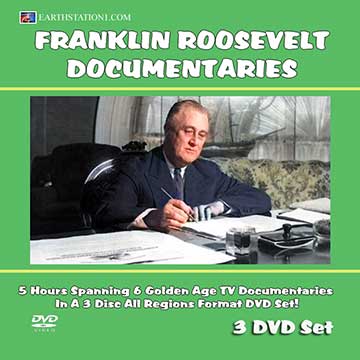
November 19, 1939: The Presidential
Library System: Presidential Libraries (Presidential Centers,
Presidential Museums) (United States): The Franklin D. Roosevelt
Presidential Library And Museum: -- Construction of the first
presidential library, The Franklin D. Roosevelt Presidential
Library And Museum, begins as President Franklin D. Roosevelt lays
the cornerstone next to his home in Hyde Park, New York. Roosevelt
donated the land, but public donations funded the library building
which was dedicated on June 30, 1941. In front of an estimated
1,000 onlookers, Roosevelt placed inside the cornerstone a metal
box containing several items including the Articles of
Incorporation of the Franklin D. Roosevelt Library, Inc.; several
congressional resolutions, reports, and hearings related to the
library; copies of deeds related to the property; the text of an
address on the Roosevelt Library by Archivist of the United States
R.D.W. Connors spoken before a meeting of the 1939 Society of
American Archivists; and copies of New York daily newspapers from
November 19, 1939. It is the first Presidential library within the
National Archives. On Sale @ 15% Off Discount Till Midnight PT!
https://store.earthstation1.com/franklin-roosevelt-documentaries-dual-layer-dvd.html
Today's
EarthStation1.com 15% Off Commemorative Memorial Title: The
Saboteurs Of Telemark Nazi German Atom Bomb Sabotage DVD, MP4, USB
Today, November 19, 2025
November 19, 1942: The European Civil
War: World War II: The Second European War (The European Theater
Of World War II): The Western Front Of World War II: The German
Nuclear Weapons Program (German: Uranverein, "Uranium Club",
Uranprojekt, "Uranium Project": The Norwegian Heavy
Water Sabotage (Bokmal: Tungtvannsaksjonen; Nynorsk:
Tungtvassaksjonen) (The Telemark Raids): Operation Freshman: --
British paratroopers launch a brave but unsuccessful attempt to
sabotage the German heavy water production facilities, intended to
help Nazi Germany build an atomic bomb, at Telemark, Norway. The
Norwegian Heavy Water Sabotage (Bokmal: Tungtvannsaksjonen;
Nynorsk: Tungtvassaksjonen) was a series of Allied-led efforts to
halt German heavy water production via hydroelectric plants in
Nazi Germany-occupied Norway during World War II, involving both
Norwegian commandos and Allied bombing raids. During the war, the
Allies sought to inhibit the German development of nuclear weapons
with the removal of heavy water and the destruction of heavy-water
production plants. The Norwegian heavy water sabotage was aimed at
the 60 MW Vemork power station at the Rjukan waterfall in
Telemark. The hydroelectric power plant at Vemork was built in
1934. It was the world's first site to mass-produce heavy water
(as a byproduct of nitrogen fixing), with a capacity of 12 tonnes
per year. Before the German invasion of Norway on 9 April 1940,
the French Deuxieme Bureau removed 185 kilograms (408 lb) of heavy
water from the Vemork plant in then-neutral Norway. The plant's
managing director agreed to lend France the heavy water for the
duration of the war. The French transported it secretly to Oslo,
then to Perth, Scotland, and then to France. The plant was still
capable of producing heavy water, however, and the Allies were
concerned that the Germans would use the facility to produce more
heavy water. Between 1940 and 1944, a series of sabotage actions
by the Norwegian resistance movement and Allied bombing ensured
the destruction of the plant and the loss of its heavy water.
These operations - code-named Grouse, Freshman, and Gunnerside -
knocked the plant out of production in early 1943. In Operation
Grouse, the British Special Operations Executive (SOE)
successfully placed an advance team of four Norwegians on the
Hardanger Plateau above the plant in October 1942. The
unsuccessful Operation Freshman was mounted the following month by
British paratroopers, who were to rendezvous with the Operation
Grouse Norwegians and proceed to Vemork. This attempt failed when
the military gliders (and one of their tugs, a Handley Page
Halifax) crashed short of their destination. Except for the crew
of one Halifax bomber, all the participants were killed in the
crashes or captured, interrogated and executed by the Gestapo. In
February 1943, a team of SOE-trained Norwegian commandos destroyed
the production facility in Operation Gunnerside; this was followed
by Allied bombing raids. The Germans ceased operations, and
attempted to move the remaining heavy water to Germany. Norwegian
resistance forces then sank the ferry carrying the heavy water,
the SF Hydro, on Lake Tinn. On Sale @ 15% Off Discount Till
Midnight PT!
https://store.earthstation1.com/the-saboteurs-of-telemark-dvd-nazi-heavy-water-sabotage.html
Today's
EarthStation1.com 15% Off Commemorative Memorial Title: The Battle
Of Stalingrad DVD, MP4 Video Download, USB Flash Drive
Today, November 19, 2025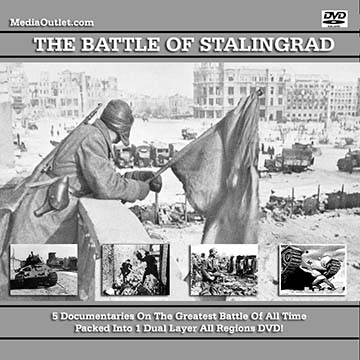
November 19, 1942: The European Civil
War: World War II: The Second European War (The European Theater
Of World War II): The Eastern Front Of World War II: The Great
Patriotic War (The German-Soviet War): The Battle Of Stalingrad:
Operation Uranus (Russian: Operatsiya Uran): -- At 07:20 Moscow
time, the Soviet Red Army under General Georgy Zhukov begin
Operation Uranus with at attack on the northern flank of the Axis
forces at Stalingrad. Operation Uranus (Russian: Operatsiya Uran)
was the codename of the massive Soviet November 19-23, 1942
strategic counter-offensive operation against the invading Nazi
Germans led by Field Marshal Friedrich Von Paulus at Stalingrad,
which led to the encirclement of the German Sixth Army, the Third
and Fourth Romanian armies, and portions of the German Fourth
Panzer Army, ultimately bringing about the liberation of the city
and the beginnning of a string of victories by the Soviets against
Nazi Germany. The operation was executed at roughly the midpoint
of the five-month long Battle Of Stalingrad, and was aimed at
destroying German forces in and around Stalingrad. Planning for
Operation Uranus had commenced in September 1942, and was
developed simultaneously with plans to envelop and destroy German
Army Group Center (Operation Mars) and German forces in the
Caucasus. The Red Army took advantage of the German army's poor
preparation for winter, and the fact that its forces in the
southern Soviet Union were overstretched near Stalingrad, using
weaker Romanian troops to guard their flanks; the offensives'
starting points were established along the section of the front
directly opposite Romanian forces. These Axis armies lacked heavy
equipment to deal with Soviet armor. Due to the length of the
front created by the German summer offensive, aimed at taking the
Caucasus oil fields and the city of Stalingrad, German and other
Axis forces were forced to guard sectors beyond the length they
were meant to occupy. The situation was exacerbated by the German
decision to relocate several mechanized divisions from the Soviet
Union to Western Europe. Furthermore, units in the area were
depleted after months of fighting, especially those which took
part in the fighting in Stalingrad. The Germans could only count
on the XXXXVIII Panzer Corps, which had the strength of a single
panzer division, and the 29th Panzergrenadier Division as reserves
to bolster their Romanian allies on the German Sixth Army's
flanks. In comparison, the Red Army deployed over one million
personnel for the purpose of beginning the offensive in and around
Stalingrad. Soviet troop movements were not without problems, due
to the difficulties of concealing their build-up, and to Soviet
units commonly arriving late due to logistical issues. Operation
Uranus was first postponed from November 8 to 17, then to November
19. Soviet forces of Operation Uranus located in the south began
their offensive operations on November 20. Although Romanian units
were able to repel the first attacks, by the end of November 20
the Third and Fourth Romanian armies were in headlong retreat, as
the Red Army bypassed several German infantry divisions. German
mobile reserves were not strong enough to parry the Soviet
mechanized spearheads, while the Sixth Army did not react quickly
enough nor decisively enough to disengage German armored forces in
Stalingrad and reorient them to defeat the impending threat. By
late November 22 Soviet forces linked up at the town of Kalach,
encircling some 290,000 men east of the Don River. Instead of
attempting to break out of the encirclement, German leader Adolf
Hitler decided to keep Axis forces in Stalingrad and resupply them
by air. In the meantime, Soviet and German commanders began to
plan their next movements. On Sale @ 15% Off Discount Till
Midnight PT!
https://store.earthstation1.com/battle-of-stalingrad-dual-layer-dvd.html
Today's
EarthStation1.com 15% Off Commemorative Memorial Title: Ronald
Reagan Documentary Biography DVD, Video Download, USB Drive
Today, November 19, 2025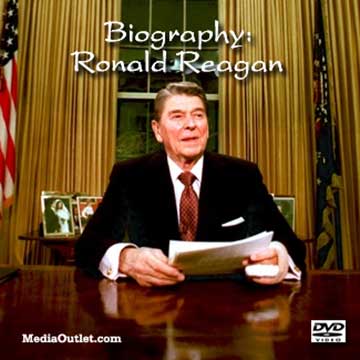
November 19, 1962: #BOTD: #HBD! Jodie
Foster, American actress, director, film producer, filmmaker and
beauty, is born Alicia Christian Foster in Los Angeles,
California. She is the recipient of numerous accolades, including
two Academy Awards, three British Academy Film Awards, three
Golden Globe Awards, and the honorary Cecil B. DeMille Award. For
her work as a director, she has been nominated for a Primetime
Emmy Award. People magazine named her the most beautiful woman in
the world in 1992, and in 2003, she was voted Number 23 in Channel
4's countdown of the 100 Greatest Movie Stars of All Time.
Entertainment Weekly named her 57th on their list of 100 Greatest
Movie Stars of All Time in 1996. In 2016, she was inducted into
the Hollywood Walk of Fame with a motion pictures star located at
6927 Hollywood Boulevard. Foster began her professional career as
a child model at age three and made her acting debut in 1968 in
the television sitcom Mayberry R.F.D. In the late 1960s and early
1970s, she worked in multiple television series and made her film
debut with Disney's Napoleon and Samantha (1972). Following
appearances in the musical Tom Sawyer (1973) and Martin Scorsese's
comedy-drama Alice Doesn't Live Here Anymore (1974), her
breakthrough came with Scorsese's psychological thriller Taxi
Driver (1976), in which she played a child prostitute, and
received a nomination for the Academy Award for Best Supporting
Actress. Her other roles as a teenager include the comedy musical
Bugsy Malone (1976) and the thriller The Little Girl Who Lives
Down the Lane (1976), and she became a popular teen idol by
starring in Disney's Freaky Friday (1976) and Candleshoe (1977),
as well as Carny (1980) and Foxes (1980). After attending Yale
University, Foster struggled to transition into adult roles until
she garnered critical acclaim for playing a rape survivor in the
legal drama The Accused (1988), for which she won the Academy
Award for Best Actress. She won her second Academy Award three
years later for the psychological horror film The Silence of the
Lambs (1991), in which she portrayed FBI agent Clarice Starling.
She made her debut as a film director the same year with Little
Man Tate. She founded her own production company, Egg Pictures, in
1992. Its first production was Nell (1994), in which Foster also
played the title role, receiving her fourth Academy Award
nomination. Her other successful films in the 1990s were the
romantic drama Sommersby (1993), western comedy Maverick (1994),
science fiction Contact (1997), and period drama Anna and the King
(1999). Foster experienced career setbacks in the early 2000s,
including the cancellation of a film project and the closing down
of her production company, but she then starred in four
commercially successful thrillers: Panic Room (2002), Flightplan
(2005), Inside Man (2006), and The Brave One (2007). She has
concentrated on directing in the 2010s, with the films The Beaver
(2011) and Money Monster (2016), and episodes for Netflix
television series Orange Is the New Black, House of Cards, and
Black Mirror. She received her first Primetime Emmy Award
nomination for Outstanding Directing for a Comedy Series for
"Lesbian Request Denied", the third episode of the
former. She also starred in the films Carnage (2011), Elysium
(2013), Hotel Artemis (2018), and The Mauritanian (2021), with the
latter winning Foster her third Golden Globe Award. On Sale @ 15%
Off Discount Till Midnight PT!
https://store.earthstation1.com/ronald-reagan-dvd-tv-biography.html
Today's
EarthStation1.com 15% Off Commemorative Memorial Title: Gorbachev:
The Rise And Fall + Oleg Gordievsky Doc MP4 Download DVD
Today, November 19, 2025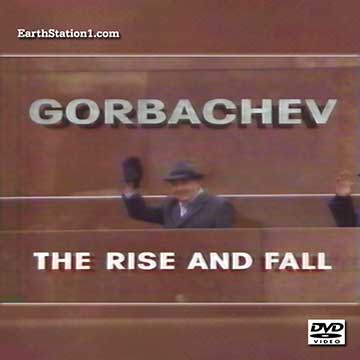
November 19-20, 1985: United
States-Soviet Union Relations (US-Soviet Relations, US-USSR
Relations): United States-Soviet Union Diplomatic Conferences
(US-Soviet Diplomatic Conferences, US-USSR Diplomatic
Conferences): The Aftermath Of World War II: The Cold War: The
Geneva Summit Of 1985: -- The Geneva Summit Of 1985: U.S.
President Ronald Reagan and Soviet Union leader Mikhail Gorbachev
meet for the first time in Geneva, Switzerland. It was held to
hold talks on international diplomatic relations and the arms
race. Both the Soviet Union and the United States were seeking to
cut the number of nuclear weapons, with the Soviets seeking to
halve the number of nuclear-equipped bombers and missiles, and the
U.S. desiring to ensure that neither side gained a first-strike
advantage, and to protect rights to have defensive systems.
Diplomats struggled to come up with planned results in advance,
with Soviets rejecting the vast majority of the items that U.S.
negotiators proposed. With the meeting planned months in advance,
the two superpowers used the opportunity to posture and to stake
their positions in the court of public opinion. Reagan's security
advisor Robert McFarlane announced that they were having "real
trouble establishing a dialogue" with the Soviets, and
announced a first test for the Strategic Defense Initiative
missile defense. The Soviets announced a unilateral moratorium on
underground nuclear tests and invited the Americans to join them,
a request that was rebuffed. On November 19, 1985, U.S. president
Ronald Reagan and Soviet General Secretary Mikhail Gorbachev met
for the first time, in Geneva, to hold talks on international
diplomatic relations and the arms race. The meeting was held at
Maison de Saussure, a chateau rented by His Highness the Aga Khan.
Gorbachev later said: "We viewed the Geneva meeting
realistically, without grand expectations, yet we hoped to lay the
foundations for a serious dialogue in the future." Similar to
former president Eisenhower in 1955, Reagan believed that a
personal relationship among leaders was the necessary first step
to breaking down the barriers of tension that existed between the
two countries. Reagan's goal was to convince Gorbachev that
America desired peace above all else. Reagan described his hopes
for the summit as a "mission for peace". The first thing
Reagan said to Gorbachev was "The United States and the
Soviet Union are the two greatest countries on Earth, the
superpowers. They are the only ones who can start World War 3, but
also the only two countries that could bring peace to the world".
He then emphasized the personal similarities between the two
leaders, with both being born in similar "rural hamlets in
the middle of their respective countries" and the great
responsibilities they held. Their first meeting exceeded their
time limit by over a half an hour. A Reagan assistant asked
Secretary Of State George Shultz whether he should interrupt the
meeting to end it by its allotted time. Shultz responded, "If
you think so, then you shouldn't have this job." The first
day, Mikhail Gorbachev argued that the United States did not trust
them and that its ruling class was trying to keep the people
uneasy. Ronald Reagan countered that the Soviets had been acting
aggressively and suggested the Soviets were overly paranoid about
the United States (The Soviets had refused to allow American
planes use Soviet airfields in post-World War II Germany). They
broke for lunch and Reagan promised Gorbachev he'd have a chance
to rebut. They talked outside for about two hours on the Strategic
Defense Initiative, but both stood firm. Gorbachev accepted
Reagan's invitation to the United States in a year, and Reagan was
invited to do the same in 1987. On the second day, Reagan went
after human rights, saying that he did not want to tell Gorbachev
how to run his country, but that he should ease up on emigration
restrictions. Gorbachev claimed that the Soviets were comparable
to the United States and quoted some feminists. The next session
started with arguments about the arms race, then went into SDI.
They agreed to a joint statement. The two leaders held similar
meetings over the next few years to further discuss the topics.
Gorbachev then held summits with George H.W. Bush after the latter
became president, starting with the Malta Summit in 1989. On Sale
@ 15% Off Discount Till Midnight PT!
https://store.earthstation1.com/gorbachev-the-rise-and-fall-dvd-mp4-usb-flash-driv4.html
Today's
EarthStation1.com 15% Off Commemorative Memorial Title: Global
Rivals: History Of Cold War w/Marvin Kalb DVD, MP4, USB Drive
Today, November 19, 2025
November 19-20, 1990: The Aftermath Of
World War II: The Cold War: Arms Control: Arms Control Treaties:
The Treaty On Conventional Armed Forces In Europe: The Treaty On
Conventional Armed Forces In Europe: The Treaty On Conventional
Armed Forces In Europe Signature Ceremony In Paris: -- The Cold
War comes to an end (though only for a generation in time as
events have shown) during a summit in Paris as leaders of NATO and
the Warsaw Pact signed a Treaty On Conventional Armed Forces In
Europe, vastly reducing their military arsenals. The original
Treaty on Conventional Armed Forces in Europe (CFE) was negotiated
and concluded during the last years of the Cold War and
established comprehensive limits on key categories of conventional
military equipment in Europe (from the Atlantic to the Urals) and
mandated the destruction of excess weaponry. The treaty proposed
equal limits for the two "groups of states-parties", the
North Atlantic Treaty Organization (NATO) and the Warsaw Pact. In
2007, Russia "suspended" its participation in the
treaty, and on March 10, 2015, citing NATO's de facto breach of
the Treaty, Russia formally announced it was "completely"
halting its participation in it as of the next day. On Sale @ 15%
Off Discount Till Midnight PT!
https://store.earthstation1.com/global-rivals-history-of-cold-war-w-mavin-kalb-dvd-mp4-usb-driv4.html
Today's
EarthStation1.com #OnThisDay Commemorative Memorial Title: Jack
Paar Late-Night TV Talk Shows DVD, MP4 Download, USB Flash Drive
Today, November 19, 2025 November 19: World Toilet Day: -- An
annual observance designated by The United Nations General
Assembly, and is coordinated every year by a partnership between
UN-Water and governments around the world. Today, we talk about
the one invention that's kept hidden behind closed doors, but is
undeniably important, and so this day is an "ode to the
commode". Jack Sim, a philanthropist from Singapore, founded
the World Toilet Organization on November 19, 2001, subsequently
declaring the day World Toilet Day. The WTO chose "World
Toilet Day" as opposed to "World Sanitation Day"
for ease of public messaging, though toilets are only the first
stage of sanitation apparatuses. World Toilet Day was made to
spread and increase public awareness of broader sanitations
systems such as wastewater treatment, stormwater management, and
hand washing. Goal 6 of the UN Sustainable Development Goals calls
for adequate sanitation, which includes the system assuring that
waste is safely processed. Their efforts to call attention to the
sanitation crises were strengthened in 2010 when the right to
water and sanitation was officially declared a human right by the
UN. In 2013, a joint effort between the Government of Singapore
and the World Toilet Organization led to Singapore's first UN
resolution called "Sanitation for All." This resolution
called for the collective action to end the world sanitation
crises. As a result, World Toilet Day was declared an official UN
day and the resolution was adopted by 122 countries at the 67th
session of the UN General Assembly in New York. During World
Toilet Day 2015, United Nations Secretary-General Ban Ki-Moon
advocated action to renew efforts to provide access to
satisfactory sanitation for all, reminding everyone of the "Call
to Action on Sanitation" which was launched in 2013 and aimed
to end open defecation by 2025.
https://store.earthstation1.com/jack-paar-tv-shows-old-time-television-dual-layer-dvd.html
November 19: World Toilet Day: -- An
annual observance designated by The United Nations General
Assembly, and is coordinated every year by a partnership between
UN-Water and governments around the world. Today, we talk about
the one invention that's kept hidden behind closed doors, but is
undeniably important, and so this day is an "ode to the
commode". Jack Sim, a philanthropist from Singapore, founded
the World Toilet Organization on November 19, 2001, subsequently
declaring the day World Toilet Day. The WTO chose "World
Toilet Day" as opposed to "World Sanitation Day"
for ease of public messaging, though toilets are only the first
stage of sanitation apparatuses. World Toilet Day was made to
spread and increase public awareness of broader sanitations
systems such as wastewater treatment, stormwater management, and
hand washing. Goal 6 of the UN Sustainable Development Goals calls
for adequate sanitation, which includes the system assuring that
waste is safely processed. Their efforts to call attention to the
sanitation crises were strengthened in 2010 when the right to
water and sanitation was officially declared a human right by the
UN. In 2013, a joint effort between the Government of Singapore
and the World Toilet Organization led to Singapore's first UN
resolution called "Sanitation for All." This resolution
called for the collective action to end the world sanitation
crises. As a result, World Toilet Day was declared an official UN
day and the resolution was adopted by 122 countries at the 67th
session of the UN General Assembly in New York. During World
Toilet Day 2015, United Nations Secretary-General Ban Ki-Moon
advocated action to renew efforts to provide access to
satisfactory sanitation for all, reminding everyone of the "Call
to Action on Sanitation" which was launched in 2013 and aimed
to end open defecation by 2025.
https://store.earthstation1.com/jack-paar-tv-shows-old-time-television-dual-layer-dvd.html
Today's
EarthStation1.com #OnThisDay Commemorative Memorial Title: Gimme
That Old Time Christmas! Holiday Films DVD, MP4 Download, USB
Today, November 19, 2025November 19: Have A Bad Day Day: -- Today
provides the ideal opportunity for those who must wish others a
happy day while having a bad day themselves. The idea behind the
day is that people do not have to mask their actual feelings and
embrace the truth. It is also a glorious day for pranksters to
confuse others by wishing them a bad day. It is a major day for
people in customer service to showcase their true emotions to
their customers, who are just used to seeing happy faces. Just
remember to be aware of who can handle such a greeting and who
can't! We are all humans, and it is very human to have a bad day.
The problem is that we are usually not able to express it. Society
has a way of making people hide their true feelings and forcing
them to smile even when they want to cry. Have a Bad Day Day was
created by Thomas Roy and his wife Ruth. They created this day,
along with so many other interesting and thought-provoking days.
People in the customer service sector are the primary
beneficiaries of this day. Because they are the people who have to
put up a facade of a smiling face and politeness every day in
front of their customers. The idea behind this special day is that
there should at least be a day when people can open up about their
true feelings without being judged or tormented for doing so. You
can also celebrate the day if you love to open up without being
judged, or if you want to cause a bit of confusion and chaos just
for fun. The day is also a perfect opportunity to prank and
confuse others. Hey, we are not judgmental. Who wouldn't want to
cause a bit of mayhem then and now? The real potential of the day
lies in opening up. People do not have to hide their pain inside
and put on a mask of a smiling face for others to be polite.
Taking a day to truly express that it is a bad day can help lose
some weight from a heavy heart. This is a day when people can
shout out their feelings without being judged or being impolite.
It is also good to have a change in tone once a year. What is life
without a bit of fun? So, tell the world to have a bad day and do
it with the brightest smile you can muster.
https://store.earthstation1.com/gimme-that-old-time-christmas-classic-yuletide-holiday-films-dvd.html
Today's
EarthStation1.com #OnThisDay Commemorative Memorial Title: The
Indomitable Teddy Roosevelt w/ George C Scott DVD, Download, USB
Today, November 19, 2025November 19, 1897: #BOTD: #HBD! Quentin
Roosevelt, American lieutenant and pilot, youngest son of
President Theodore Roosevelt and First Lady Edith Roosevelt (d.
July 14, 1918) is #born Quentin Roosevelt I in Washington, D.C.
into Theodore Roosevelt's family, which included half-sister
Alice, sister Ethel, and brothers Ted (Theodore III), Kermit, and
Archie. Quentin was three years old when his father became
president, and he grew up in the White House. By far the favorite
of all of President Roosevelt's children, Quentin was also the
most rambunctious. Quentin's behavior prompted his mother, Edith,
to label him a "fine bad little boy". Amongst Quentin's
many adventures with the "White House Gang" (a name
assigned by T.R. to Quentin and his friends, which included
William Taft's son, and Roswell Pinckney, future state department
official and son of African American White House steward Henry
Pinckney), Quentin carved a baseball diamond on the White House
lawn without permission, defaced official presidential portraits
in the White House with spitballs, threw snowballs from the White
House's roof at unsuspecting Secret Service guards, and
occasionally rode on top of the family elevator with his friend,
Charlie Taft, the son of Secretary of War and future President
William Howard Taft. The Secret Service were alarmed to see a fire
and smoke behind the White House, only to see Quentin with a
makeshift brick stove baking some potatoes. He quickly became
known for his humorous and sometimes philosophical remarks. To a
reporter trying to trap the boy into giving information about his
father, Quentin admitted, "I see him occasionally, but I know
nothing of his family life." The family soon learned to keep
him quiet during dinner when important guests were present. Once,
when his brother Archie was terribly ill, it was Quentin (with the
help of Charles Lee, a White House coachman) who brought the pony
Algonquin to his room by elevator, sure that this would make his
brother smile. Quentin started his education at Force Elementary
School and then attended the Episcopal High School in Alexandria,
Virginia. Later he was a student at the Evans School for Boys and
Groton School. Quentin consistently scored high marks and
displayed the intellectual prowess of his father. He was admitted
to Harvard University in 1915. By the time Quentin was a sophomore
at Harvard, also like his father, he was showing promise as a
writer. Quentin Roosevelt died when he was killed in aerial combat
over France on Bastille Day, the only child of a U.S. president to
have died in combat. Quentin Roosevelt was posthumously awarded an
A.B. (War Degree) by Harvard, Class of 1919. Three German pilots
have been credited with Quentin's shootdown and death at various
times, and all three of them may have been his killer. Leutnant
Karl Thom of Jasta 21, one of the greatest German flying aces of
the war, was in the vicinity and had confirmed kills nearby; he
was often credited with Quentin's downing, but never claimed the
kill.[citation needed] Leutnant Christian Donhauser of Jasta 17
claimed credit and publicized himself as Quentin's killer after
the war.[citation needed] Sergeant Carl Graeper of Jasta 50 also
claimed credit, but if he did fire the fatal shots, it was his
only kill during the war.[citation needed] All three of them may
have been in the dogfight which claimed Quentin's life. A clipping
from the Kolnische Zeitung obtained through the Spanish Embassy
gave this account of the fight: "The aviator of the American
Squadron, Quentin Roosevelt, in trying to break through the
airzone over the Marne, met the death of a hero. A formation of
seven German airplanes, while crossing the Marne, saw in the
neighborhood of Dormans a group of twelve American fighting
airplanes and attacked them. A lively air battle began, in which
one American (Quentin) in particular persisted in attacking. The
principal feature of the battle consisted in an air duel between
the American and a German fighting pilot named Sergeant Greper.
After a short struggle, Greper succeeded in bringing the brave
American just before his gun-sights. After a few shots the plane
apparently got out of his control; the American began to fall and
struck the ground near the village of Chamery, about ten
kilometers north of the Marne. The American flier was killed by
two shots through the head. Papers in his pocket showed him to be
Quentin Roosevelt, of the United States army. His effects are
being taken care of in order to be sent to his relatives. He was
buried by German aviators with military honors. The German pilot
who shot down Quentin Roosevelt told me of counting twenty bullet
holes in his machine when he landed after the fight. He survived
the war but was killed in an accident while engaged in delivering
German airplanes to the American Forces under the terms of the
Armistice." Funeral services held by the Germans were
witnessed on July fifteenth by Captain James E. Gee of the 110th
Infantry, who had been captured and was being evacuated to the
rear. Gee passed through Chamery, the little village near which
the plane crashed to earth. He thus describes the scene: "n a
hollow square about the open grave were assembled approximately
one thousand German soldiers, standing stiffly in regular lines.
They were dressed in field gray uniforms, wore steel helmets, and
carried rifles. Near the grave was a smashed plane, and beside it
was a small group of officers, one of whom was speaking to the
men. I did not pass close enough to hear what he was saying; we
were prisoners and did not have the privilege of lingering, even
for such an occasion as this. At the time I did not know who was
being buried, but the guards informed me later. The funeral
certainly was elaborate. I was told afterward by Germans that they
paid Lieut. Roosevelt such honor not only because he was a gallant
aviator, who died fighting bravely against odds, but because he
was the son of Colonel Roosevelt whom they esteemed as one of the
greatest Americans." On July 18, in a great allied
counter-attack, the village where Quentin fell was retaken from
the Germans, and his grave was found by some American soldiers. At
its head was a wooden cross, on which was printed: "Leutnant
Q. Roosevelt | Honored and Buried by the Imperial German Army."
Following the custom that sprang up in the chivalrous environment
of the air services, the broken propeller blades and bent and
scarred wheels of the plane were marking his resting-place. Nearby
lay the shattered remains of the airplane, with the seventy-six
"wound stripes" which Quentin had painted on it, still
to be seen. The engineer regiment of the division that had retaken
Chamery marked the spot where the airplane fell, and raised a
cross at the grave with the inscription: "Here rests on the
field of honor | Quentin Roosevelt | Air Service U.S.A. | Killed
in action July 1918." The French placed an oaken enclosure
with a head-born reading: "Lieutenant | Quentin Roosevelt |
Squadron 95 | Fallen gloriously | In aerial combat | 14 July 1918
| For right | And liberty". After his grave came under Allied
control, thousands of American soldiers visited it to pay their
respects. Roosevelt's resting place became a shrine and an
inspiration to his comrades in arms. His death was a great
personal loss to his father, who understood quite well that he had
encouraged his son's entry into the War. It is said that he never
fully recovered from his son's death. Within six months, Theodore
himself would be dead. In 1955, eleven years after the World War
II, American Cemetery was established in France at
Colleville-sur-Mer, Quentin's body was exhumed and moved there.
Quentin's remains were moved in order to be buried next to his
eldest brother Ted, who had died of a heart attack in France in
1944, shortly after leading his troops in landings on Utah Beach
on D-Day as Assistant 4th Infantry Division Commander (an act
which would earn him the Medal of Honor). Quentin's original
gravestone was moved to Sagamore Hill to serve as a cenotaph for
the former president's son. The German-made basswood cross
(basswood is a tree native to Eastern North America, where The
Roosevelts were from) that marked Quentin's original gravesite is
on display at the National Museum of the United States Air Force,
at Wright-Patterson Air Force Base, in Dayton, Ohio.
https://store.earthstation1.com/the-indomitable-teddy-roosevelt-george-c-scott-john-philip-sousa-dvd.html
Today's
EarthStation1.com #OnThisDay Commemorative Memorial Title: Smokey
Robinson: The Quiet Legend DVD, MP4 Video Download, USB Drive
Today, November 19, 2025November 19, 1938: #BOTD: #HBD! Pete
Moore, African American singer-songwriter and record producer,
best known as the bass singer for Motown group The Miracles from
1955 onwards, one of the group's original members and vocal
arranger on all of the group's hits, BMI and ASCAP award-winning
songwriter (d. November 19, 2017) is #born Warren Thomas Moore in
Detroit, Michigan. A childhood friend of Miracles lead singer
Smokey Robinson, the two met at a musical event given by the
Detroit Public School system, where Moore spotted Robinson singing
as part of the show. The two became friends and formed a singing
group, which eventually became the Miracles. Moore co-wrote
several of The Miracles' own hits. These included "Ooo Baby
Baby" (1965), the million-selling Grammy Hall of Fame
Inductee "The Tracks of My Tears" (also 1965), for which
he won the ASCAP Award Of Merit, "My Girl Has Gone",
another Top 20 hit from 1965, "Going to a Go-Go" (also
1965), (where he came up with the song's initial percussion
sequence), and the multi-million selling #1 Pop smash, "Love
Machine" (co-written with Miracles' member Billy Griffin) and
the platinum album from which it came, City of Angels, among
others. Moore as leader of the Miracles enjoyed other hits with
Griffin i.e. Do it Baby which was the Miracles first major hit
after Smokey left the group. Besides his work in the Miracles,
Moore helped Robinson write several hit songs, including The
Temptations' "It's Growing" and "Since I Lost My
Baby", and two of Marvin Gaye's biggest hits, the Top 10
million sellers, "Ain't That Peculiar" and "I'll Be
Doggone". Moore and the group signed a management agreement
with Martin Pichinson who also managed Lou Rawls and Bill Withers.
Pichinson was very instrumental in developing the new direction
for the Miracles.
https://store.earthstation1.com/smokey-robinson-the-quiet-legend-dvd-mp4-download-usb-driv4.html
Today's
EarthStation1.com #OnThisDay Commemorative Memorial Title: The
Golden Age Of Rock 'N' Roll DVD, MP4 Video Download, Flash Drive
Today, November 19, 2025November 19, 2017: #DOTD: #RIP: Pete
Moore, African American singer-songwriter and record producer,
best known as the bass singer for Motown group The Miracles from
1955 onwards, one of the group's original members and vocal
arranger on all of the group's hits, BMI and ASCAP award-winning
songwriter (b. November 19, 1938) #dies on his 79th birthday in
Las Vegas, Nevada due to complications of diabetes. He is buried
at Palm Memorial Park Northwest in Las Vegas, Nevada. In a tribute
to Pete, Motown Records founder Berry Gordy stated: "I am
deeply saddened to hear of the passing of Warren 'Pete' Moore, a
fine human being and valued member of the Motown family,"
Gordy said. "Pete was an original member of my very first
group, the Miracles. He was a quiet spirit with a wonderful Bass
voice behind Smokey Robinson's soft, distinctive lead vocals and
was co-writer on several of the Miracles hits." Original
Miracles member Claudette Rogers-Robinson placed flowers on the
Miracles' Hollywood Walk of Fame Star on November 21, 2017, in
Hollywood, California in tribute to Moore. According to Tina, his
wife of over 40 years, the cause of death was complications of
diabetes. Besides his wife, Pete was survived by his sister,
Winifred Moore, and adult twin daughters, Monette and Monique. The
deaths of White, Tarplin, Rogers and Moore leave Smokey Robinson
and Claudette Rogers-Robinson as the last surviving original
members of The Miracles as of late 2020.
https://store.earthstation1.com/the-golden-age-of-rock-39n39-roll-dvd-complete-tv-series-5-39395.html
Today's
EarthStation1.com #OnThisDay Commemorative Memorial Title: Frank
Zappa Documentaries MP4 Video Download DVD
Today, November 19, 2025November 19, 1936: #BOTD: #HBD! Ray
Collins, American singer, guitarist and harmonica player, best
known as a member of The Mothers Of Invention (d. December 24,
2012) is #born. Collins grew up in Pomona, California singing in
his school choir, the son of a local police officer. He quit high
school to get married. Collins started his musical career singing
falsetto backup vocals for various doo-wop groups in the Los
Angeles area in the late 1950s and early 1960s, including Little
Julian Herrera and the Tigers. In 1964, Collins, drummer Jimmy
Carl Black, bassist Roy Estrada, saxophonist Dave Coronado, and
guitarist Ray Hunt formed The Soul Giants. Hunt was eventually
replaced by Frank Zappa, and the group evolved into the Mothers of
Invention. Ray was the lead vocalist on most songs for their early
albums, including Freak Out!, Absolutely Free, Cruising with Ruben
& the Jets and Uncle Meat. He additionally provided harmonica
on Freak Out!. In 1968 Ray quit The Mothers of Invention and was
replaced by Lowell George, but continued to contribute to other
Zappa projects through the mid-1970s. Currently Ray Collins
niece/protege Shay Collins has been leading her own mission to
carry on the name and memory of Ray Collins, with an American rock
duo Mother Legacy. Labeling herself as Ray's legacy, determined to
carry on all of his teachings and steadfast beliefs and desires in
music. Collins resided in Claremont, California in a back yard van
until his death of a heart attack sustained days earlier at age
76. His remains were cremated; the final disposition of his
cremains is unknown.
https://store.earthstation1.com/frank-zappa-documentaries-mp4-video-download-dv4.html
Today's
EarthStation1.com #OnThisDay Commemorative Memorial Title:
Complete TV Music & Dance MegaSet DVDs, Downloads, USB Flash
Drives
Today, November 19, 2025November 19, 2004: #DOTD: #RIP: Terry
Melcher, American record producer, singer, and songwriter who was
instrumental in shaping the mid-to-late 1960s California Sound and
folk rock movements (b. February 8, 1942) #dies at his home in
Beverly Hills, California after a long battle with melanoma, aged
62. His remains were cremated, and his remains were given to his
mother, Doris Day. He was born Terrence Paul Jorden in New York
City, the only child of actress and singer Doris Day; his father
was Day's first husband, trombonist Al Jorden. Known as "Terry",
the boy was named by his mother after the hero of her favorite
childhood comic strip, Terry and the Pirates. He was adopted by
her third husband, Martin Melcher. Terry Melcher's best-known
contributions were producing the Byrds' first two albums Mr.
Tambourine Man (1965) and Turn! Turn! Turn! (1965), as well as
most of the hit recordings of Paul Revere & the Raiders and
Gentle Soul. Most of his early recordings were with the vocal surf
acts the Rip Chords and Bruce & Terry. In the 1960s, Melcher
was acquainted with the Beach Boys and later produced several
singles for the group in the 1980s and the 1990s, including
"Kokomo" (1988), which topped U.S. record charts. He is
also known for his collaborations with Bruce Johnston and for his
association with the Manson Family.
https://store.earthstation1.com/14-disc-classic-tv-music-amp-dance-shows-discount-dvd-megas14.html
Today's
EarthStation1.com #OnThisDay Commemorative Memorial Title: Charles
Manson: A Documentary History DVD, MP4 Download, USB Drive
Today, November 19, 2025November 19, 2017: #DOTD: Charles Manson,
American convicted mass murderer and former cult leader who led
what became known as the Manson Family, a quasi-commune that arose
in California in the late 1960s (b. November 12, 1934) #dies at
Mercy Hospital in downtown Bakersfield, California, aged 83.
Manson's grandson Jason Freeman had Manson cremated on March 20,
2018 following a small, private Christian funeral in Porterville,
California. His ashes were variously distributed; some were spread
along a nearby creek bed in a forest in the Sierra Mountains
during the funeral service, some were scattered in The Gulf Of
Mexico in a spot between Bradenton and St. Petersburg, and some
were given to Manson Family member Sandra Good. Charles Milles
Manson was born Charles Milles Maddox to fifteen-year-old Kathleen
Manson-Bower-Cavender, nee Maddox (1919-1973), in the University
of Cincinnati Academic Health Center in Cincinnati, Ohio. Manson's
biological father appears to have been Colonel Walker Henderson
Scott Sr. (1910-1954) of Catlettsburg, Kentucky, against whom
Kathleen Maddox filed a paternity suit that resulted in an agreed
judgment in 1937. Scott worked intermittently in local mills, and
had a local reputation as a con artist. He allowed Maddox to
believe that he was an army colonel, although "Colonel"
was merely his given name. When Maddox told Scott that she was
pregnant, he told her he had been called away on army business;
after several months she realized he had no intention of
returning. Manson may never have known his biological father. He
was named Charles Milles Maddox. Charles Manson's followers
committed a series of nine murders at four locations in July and
August 1969. In 1971 he was found guilty of first-degree murder
and conspiracy to commit murder for the deaths of seven people:
most notably of the actress Sharon Tate: all of which were carried
out by members of the group at his instruction. Manson also
received first-degree murder convictions for two other deaths.
Manson was originally sentenced to death, but his sentence was
commuted to life imprisonment when California invalidated the
state's death penalty statute in 1972. He is currently serving
multiple life sentences at California State Prison in Corcoran.
Manson believed in what he called "Helter Skelter", a
term he took from the Beatles' song of the same name. Manson
believed Helter Skelter to be an impending apocalyptic race war,
which he described in his own version of the lyrics to the
Beatles' song. He believed the murders would help precipitate that
war. From the beginning of his notoriety, a pop culture arose
around him in which he ultimately became an emblem of insanity,
violence and the macabre. At the time the Family began to form,
Manson was an unemployed former convict, who had spent half of his
life in correctional institutions for a variety of offenses.
Before the murders, he was a singer-songwriter on the fringe of
the Los Angeles music industry, chiefly through a chance
association with Dennis Wilson, drummer and founding member of the
Beach Boys. After Manson was charged with the crimes of which he
was later convicted, recordings of songs written and performed by
him were released commercially. Various musicians have covered
some of his songs, including Guns N' Roses, Marilyn Manson,
Crispin Glover and GG Allin.
https://store.earthstation1.com/charles-manson-a-documentary-history-dvd-mp4-download-usb-driv4.html
Today's
EarthStation1.com #OnThisDay Commemorative Memorial Title: America
Held Hostage: As It Happened The Iran Hostage Crisis MP4 DVD
Today, November 19, 2025November 19, 1979: The Aftermath Of World
War II: The Cold War: The Cold War (1962-1979): The Iranian
Revolution: The Cold War (1979-1985): Aftermath Of The Iranian
Revolution: The Iran Hostage Crisis: -- Iranian leader Ayatollah
Ruhollah Khomeini orders the release of 13 female and black
American hostages being held at the US Embassy in Tehran. The Iran
Hostage Crisis began on November 4, 1979, when 52 United States
diplomats and citizens were taken hostage after a group of
militarized Iranian college students belonging to the Muslim
Student Followers of the Imam's Line, who supported the Iranian
Revolution, took over the U.S. Embassy in Tehran. A diplomatic
standoff ensued. The hostages were held for 444 days, being
released on January 20, 1981. Western media described the crisis
as an "entanglement" of "vengeance and mutual
incomprehension". U.S. President Jimmy Carter called the
hostage-taking an act of "blackmail" and the hostages
"victims of terrorism and anarchy". In Iran, it was
widely seen as an act against the U.S. and its influence in Iran,
including its perceived attempts to undermine the Iranian
Revolution and its longstanding support of the shah of Iran,
Mohammad Reza Pahlavi, who was overthrown in 1979. After Shah
Pahlavi was overthrown, he was admitted to the U.S. for cancer
treatment. Iran demanded his return in order to stand trial for
crimes that he was accused of committing during his reign.
Specifically, he was accused of committing crimes against Iranian
citizens with the help of his secret police. Iran's demands were
rejected by the United States, and Iran saw the decision to grant
him asylum as American complicity in those atrocities. The
Americans saw the hostage-taking as an egregious violation of the
principles of international law, such as the Vienna Convention,
which granted diplomats immunity from arrest and made diplomatic
compounds inviolable. The Shah left the United States in December
1979 and was ultimately granted asylum in Egypt, where he died
from complications of cancer at age 60 on July 27, 1980. Six
American diplomats who had evaded capture were rescued by a joint
CIA-Canadian effort on January 27, 1980. The crisis reached a
climax in early 1980 after diplomatic negotiations failed to win
the release of the hostages. Carter ordered the U.S. military to
attempt a rescue mission - Operation Eagle Claw - using warships
that included USS Nimitz and USS Coral Sea, which were patrolling
the waters near Iran. The failed attempt on April 24, 1980,
resulted in the death of one Iranian civilian and the accidental
deaths of eight American servicemen after one of the helicopters
crashed into a transport aircraft. U.S. Secretary Of State Cyrus
Vance resigned his position following the failure. In September
1980, Iraq invaded Iran, beginning the Iran-Iraq War. These events
led the Iranian government to enter negotiations with the U.S.,
with Algeria acting as a mediator. The crisis is considered a
pivotal episode in the history of Iran-United States relations.
Political analysts cited the standoff as a major factor in the
continuing downfall of Carter's presidency and his landslide loss
in the 1980 presidential election; the hostages were formally
released into United States custody the day after the signing of
the Algiers Accords, just minutes after American President Ronald
Reagan was sworn into office. In Iran, the crisis strengthened the
prestige of Ayatollah Ruhollah Khomeini and the political power of
theocrats who opposed any normalization of relations with the
West. The crisis also led to American economic sanctions against
Iran, which further weakened ties between the two countries.
https://store.earthstation1.com/america-held-hostage-as-it-happened-the-iran-hostage-crisis-mp4-dv4.html
Today's
EarthStation1.com #OnThisDay Commemorative Memorial Title: The
Weapons Of Desert Shield + Bonus Persian Gulf War DVD MP4 Download
Today, November 19, 2025November 19, 1990: The Aftermath Of World
War II: The Cold War: The Cold War (1985-1991) (The End Of The
Cold War): The Gulf War (The Persian Gulf War, Gulf War I): The
Invasion Of Kuwait: Operation Desert Shield: -- In response to the
heavy military buildup of coalition military forces on the
Saudi-Kuwaiti border, Saddam Hussein sends 200,000 more Iraqi
troops to Kuwait. Operation Desert Shield began on August 7, 1990
when US troops were sent to Saudi Arabia due also to the request
of its monarch, King Fahd, who had earlier called for US military
assistance. This "wholly defensive" doctrine was quickly
abandoned when, on August 8, Iraq declared Kuwait to be Iraq's
19th province and Saddam named his cousin, Ali Hassan Al-Majid, as
its military-governor. The US Navy dispatched two naval battle
groups built around the aircraft carriers USS Dwight D. Eisenhower
and USS Independence to the Persian Gulf, where they were ready by
August 8. The US also sent the battleships USS Missouri and USS
Wisconsin to the region. A total of 48 US Air Force F-15s from the
1st Fighter Wing at Langley Air Force Base, Virginia, landed in
Saudi Arabia, and immediately commenced round the clock air
patrols of the Saudi-Kuwait-Iraq border to discourage further
Iraqi military advances. They were joined by 36 F-15 A-Ds from the
36th Tactical Fighter Wing at Bitburg, Germany. The Bitburg
contingent was based at Al Kharj Air Base, approximately an hour
south east of Riyadh. The 36th TFW would be responsible for 11
confirmed Iraqi Air Force aircraft shot down during the war. There
were also two Air National Guard units stationed at Al Kharj Air
Base, the South Carolina Air National Guard's 169th Fighter Wing
flew bombing missions with 24 F-16s flying 2,000 combat missions
and dropping 4 million pounds of munitions, and the New York Air
National Guard's 174th Fighter Wing from Syracuse flew 24 F-16s on
bombing missions. Military buildup continued from there,
eventually reaching 543,000 troops, twice the number used in the
2003 invasion of Iraq. Much of the material was airlifted or
carried to the staging areas via fast sealift ships, allowing a
quick buildup.
https://store.earthstation1.com/the-weapons-of-desert-shield-persian-gulf-war-i-dvd-mp4-download-us4.html
Today's
EarthStation1.com #OnThisDay Commemorative Memorial Title: TV
Commercials: The Cable Age Classics I DVD, Download, USB Drive
Today, November 19, 2025November 19, 1955: Conservatism In The
United States: First Publications: -- The National Review
publishes its first issue, an American
conservative-right-libertarian editorial magazine, focusing on
news and commentary pieces on political, social, and cultural
affairs founded by author William F. Buckley Jr.. Buckley
assembled an eclectic group of writers: traditionalists, Catholic
intellectuals, libertarians and ex-Communists. The group included:
Revilo P. Oliver, Russell Kirk, James Burnham, Frank Meyer, and
Willmoore Kendall, Catholics L. Brent Bozell and Garry Wills. The
former Time editor Whittaker Chambers, who had been a Communist
spy in the 1930s, then turned intensely anti-Communist, became a
senior editor. In the magazine's founding statement Buckley wrote:
"The launching of a conservative weekly journal of opinion in
a country widely assumed to be a bastion of conservatism at first
glance looks like a work of supererogation, rather like publishing
a royalist weekly within the walls of Buckingham Palace. It is not
that of course; if National Review is superfluous, it is so for
very different reasons: It stands athwart history, yelling Stop,
at a time when no other is inclined to do so, or to have much
patience with those who so urge it." As editors and
contributors, Buckley sought out intellectuals who were
ex-Communists or had once worked on the far left, including
Whittaker Chambers, William Schlamm, John Dos Passos, Frank Meyer
and James Burnham. When James Burnham became one of the original
senior editors, he urged the adoption of a more pragmatic
editorial position that would extend the influence of the magazine
toward the political center. Smant (1991) finds that Burnham
overcame sometimes heated opposition from other members of the
editorial board (including Meyer, Schlamm, William Rickenbacker,
and the magazine's publisher William A. Rusher), and had a
significant effect on both the editorial policy of the magazine
and on the thinking of Buckley himself. National Review aimed to
make conservative ideas respectable, in an age when the dominant
view of conservative thought was, as expressed by Columbia
professor Lionel Trilling: "[L]iberalism is not only the
dominant but even the sole intellectual tradition. For it is the
plain fact that nowadays there are no conservative or reactionary
ideas in general circulation... the conservative impulse and the
reactionary impulse do not... express themselves in ideas but
only... in irritable mental gestures which seek to resemble
ideas." Since its founding, the magazine has played a
significant role in the development of conservatism in the United
States, helping to define its boundaries and promoting fusionism
while establishing itself as a leading voice on the American
right. In 1953, moderate Republican Dwight D. Eisenhower was
president, and many major magazines such as the Saturday Evening
Post, Time, and Reader's Digest were strongly conservative and
anticommunist, as were many newspapers including the Chicago
Tribune and St. Louis Globe-Democrat. A few small-circulation
conservative magazines, such as Human Events and The Freeman,
preceded National Review in developing Cold War Conservatism in
the 1950s. In 1953, Russell Kirk published The Conservative Mind,
which traced an intellectual bloodline from Edmund Burke to the
Old Right in the early 1950s. This challenged the notion among
intellectuals that no coherent conservative tradition existed in
the United States. A young William F. Buckley Jr. was greatly
influenced by Kirk's concepts. Buckley had money; his father grew
rich from oil fields in Mexico. He first tried to purchase Human
Events, but was turned down. He then met Willi Schlamm, the
experienced editor of The Freeman; they would spend the next two
years raising the 300K USD necessary to start their own weekly
magazine, originally to be called National Weekly, which was
changed to National Review when they discovered that there was
already a magazine by that name. The statement of intentions read
"Middle-of-the-Road, qua Middle of the Road, is politically,
intellectually, and morally repugnant. We shall recommend policies
for the simple reason that we consider them right (rather than
"non-controversial"); and we consider them right because
they are based on principles we deem right (rather than on
popularity polls)... The New Deal revolution, for instance, could
hardly have happened save for the cumulative impact of The Nation
and The New Republic, and a few other publications, on several
American college generations during the twenties and thirties."
William Buckley Jr. said that National Review "is out of
place because, in its maturity, literate America rejected
conservatism in favor of radical social experimentation... since
ideas rule the world, the ideologues, having won over the
intellectual class, simply walked in and started to... run just
about everything. There never was an age of conformity quite like
this one, or a camaraderie quite like the Liberals'.
https://store.earthstation1.com/tv-commercials-the-cable-age-classics-i-dvd.html
Today's
EarthStation1.com #OnThisDay Commemorative Memorial Title:
Information Please Radio Quiz Show MP3 DVD, Audio Download, USB
Drive
Today, November 19, 2025November 19, 1883: #BOTD: #HBD! Ned
Sparks, Canadian-American character actor of the American stage
and screen (d. April 3, 1957) is #born Edward Arthur Sparkman in
Guelph, Ontario, Canada. He was known for his deadpan expression
and comically nasal, monotone delivery. Ned Sparks died in
Victorville, California, on April 3, 1957, from the effects of an
intestinal blockage, aged 73. He is buried at Victor Valley
Memorial Park cemetery in Victorville, San Bernardino County,
California.
https://store.earthstation1.com/complete-information-please-quiz-show-old-time-radio-mp3-dv3.html
Today's
EarthStation1.com #OnThisDay Commemorative Memorial Title:
Pimpernel Smith (1941) Leslie Howard DVD, MP4 Download, USB Drive
Today, November 19, 2025November 19, 1956: #DOTD: #RIP: Francis
L. Sullivan, English film and stage actor (b. January 6, 1903)
#dies of a heart attack in New York City, aged 53 (some sources
claim he died from an unspecified "lung ailment"). He is
buried at Calvary Cemetery in Woodside, Queens County, New York
City. Francis L. Sullivan was born Francis Loftus Sullivan in
Wandsworth, London, England. He attended Stonyhurst, the Jesuit
public school in Lancashire, England, whose alumni include Charles
Laughton and Sir Arthur Conan Doyle. A heavily built man with a
striking double-chin and a deep voice, Sullivan made his acting
debut at the Old Vic at age 18 in Shakespeare's Richard III. He
had considerable theatrical experience before he appeared in his
first film in 1932, The Missing Rembrandt, as a German villain
opposite Arthur Wontner as Sherlock Holmes. Among his film roles
are General Von Graum in Pimpernel Smith (1941), Mr Bumble in
Oliver Twist (1948) and Phil Nosseross in the film noir Night and
the City (1950). Sullivan also played the part of the lawyer
Jaggers in two versions of Charles Dickens's Great Expectations -
in 1934 and 1946. He appeared in a fourth Dickens film, the 1935
Universal Pictures version of The Mystery of Edwin Drood, in which
he played Crisparkle. He was featured in The Citadel (1938),
starring Robert Donat, and a decade later he played the role of
Pierre Cauchon in the technicolor version of Joan of Arc (1948),
starring Ingrid Bergman. In 1938 he starred in a revival of the
Stokes brothers' play Oscar Wilde at London's Arts Theatre. He
played the Attorney-General prosecuting the case defended by
Robert Donat as barrister Sir Robert Morton, in the first film
version of The Winslow Boy (1948). Sullivan also acted in light
comedies, including My Favorite Spy (1951), starring Bob Hope and
Hedy Lamarr, in which he played an enemy agent, and the comedy
Fiddlers Three (1944), portraying Nero. He also played the role of
Pothinus in the film version of George Bernard Shaw's Caesar and
Cleopatra (1945). The film was directed by Gabriel Pascal, and was
the last film personally supervised by Shaw himself. Sullivan
reprised the role in a stage revival of the play. On television,
Sullivan starred in "The Man Who Would Be King", the 17
October 1950, episode of Suspense. Sullivan, who eventually became
a naturalised US citizen, won a Tony Award in 1955 for the Agatha
Christie play Witness for the Prosecution. Earlier, he had played
Hercule Poirot at London's Embassy Theatre in the Christie play
Black Coffee (1930). In 1935, Sullivan married stage designer
Frances Joan Perkins in Westminster in London. In 1939 they were
living at 'Hatch Hill' on Kingsley Green at Fernhurst in West
Sussex. They remained married until his death.
https://store.earthstation1.com/pimpernel-smith-dvd-leslie-howard-world-war-ii.html
Today's
EarthStation1.com #OnThisDay Commemorative Memorial Title: The
Romantic Spirit TV Series DVD, Video Download, USB Flash Drive
Today, November 19, 2025November 19, 1828: #DOTD: #RIP: Franz
Schubert, Austrian pianist and composer (b. January 31, 1797)
#dies of typhoid fever in Vienna, Austria, aged 31, at the
apartment of his brother Ferdinand. He was buried at his own
request near the grave of Beethoven, whom he had admired all his
life, in the village cemetery of Wahring on the edge of the Vienna
Woods. A year earlier he had served as a torchbearer at
Beethoven's funeral. In 1872, a memorial to Franz Schubert was
erected in Vienna's Stadtpark. In 1888, both Schubert's and
Beethoven's graves were moved to the Zentralfriedhof where they
can now be found next to those of Johann Strauss II and Johannes
Brahms. The cemetery in Wahring was converted into a park in 1925,
called the Schubert Park, and his former grave site was marked by
a bust. His epitaph, written by his friend, the poet Franz
Grillparzer, reads: Die Tonkunst begrub hier einen reichen Besitz,
aber noch viel schonere Hoffnungen ("The art of music has
here interred a precious treasure, but yet far fairer hopes").
Born Franz Peter Schubert in Himmelpfortgrund (German: "Sky
Gate", now a part of Alsergrund), Vienna, Archduchy of
Austria, he was extremely prolific during his brief lifetime. His
output consists of over 600 secular vocal works (mainly Lieder),
seven complete symphonies, sacred music, operas, incidental music
and a large body of chamber and piano music. Appreciation of
Schubert's music while he was alive was limited to a relatively
small circle of admirers in Vienna, but interest in his work
increased significantly in the decades following his death. Felix
Mendelssohn, Robert Schumann, Franz Liszt, Johannes Brahms and
other 19th-century composers discovered and championed his works.
Today, Schubert is ranked among the greatest composers of the late
Classical and early Romantic eras and is one of the most
frequently performed composers of the early 19th century.
https://store.earthstation1.com/the-romantic-spirit-tv-series-all-14-episodes-5-dual-layer-d145.html
Today's
EarthStation1.com #OnThisDay Commemorative Memorial Title: Ethnic
Notions + The Mammy Legend: Black Stereotypes DVD MP3 USB Drive
Today, November 19, 2025November 19, 1985: #DOTD: #RIP: Stepin
Fetchit, African American vaudevillian, comedian, singer, dancer
and film actor (b. May 30, 1907) #dies of pneumonia and heart
failure at the age of 83 at the Motion Picture & Television
Country House and Hospital, where he moved after suffering a
stroke in 1976 which ended his acting career. He is buried at
Calvary Cemetery in East Los Angeles, California with a Catholic
funeral Mass. Born Lincoln Theodore Monroe Andrew Perry in Key
West, Florida to West Indian immigrants of Jamaican and Bahamian
descent, Stepin Fetchit is considered to be the first Black actor
to have a successful film career. His highest profile was during
the 1930s in films and on stage, when his persona of Stepin
Fetchit was billed as the "Laziest Man in the World".
Perry parlayed the Fetchit persona into a successful film career,
becoming the first Black actor to earn 1M USD. He was also the
first Black actor to receive featured screen credit in a film.
Perry's film career slowed after 1939 and nearly stopped
altogether after 1953. Around that time, Black Americans began to
see his Stepin Fetchit persona as an embarrassing and harmful
anachronism, echoing negative stereotypes. However, the Stepin
Fetchit character has undergone a re-evaluation by some scholars
in recent times, who view him as an embodiment of the trickster
archetype.
https://store.earthstation1.com/ethnic-notions-africanamerican-stereotypes-dvd.html
Today's
EarthStation1.com #OnThisDay Commemorative Memorial Title: Darrow
(1991) Kevin Spacey TV Docudrama DVD, Video Download, USB Drive
Today, November 19, 2025November 19, 1904: #BOTD: Nathan Leopold,
American murderer (d. August 29, 1971) is #born Nathan Freudenthal
Leopold Jr. in Chicago, the son of Florence (Foreman) and Nathan
Leopold, a wealthy German Jewish immigrant family. A child
prodigy, he claimed to have spoken his first words at the age of
four months. On May 21, 1924, University of Chicago students
Richard Loeb and Nathan Leopold, Jr. murdered 14-year-old Bobby
Franks in a "thrill killing". After the two men were
arrested, Loeb's family retained Clarence Darrow as counsel for
their defense. Nathan Freudenthal Leopold Jr. (November 19, 1904 -
August 29, 1971) and Richard Albert Loeb (June 11, 1905 - January
28, 1936), usually referred to collectively as Leopold and Loeb,
were two wealthy students at the University of Chicago who in May
1924 kidnapped and murdered 14-year-old Bobby Franks in Chicago,
Illinois, United States. They committed the murder - characterized
at the time as "the crime of the century" - as a
demonstration of their ostensible intellectual superiority, which,
they thought, enabled them to carry out a "perfect crime"
and absolve them of responsibility for their actions. After the
two men were arrested, Loeb's family retained Clarence Darrow as
lead counsel for their defense. Darrow's 12-hour summation at
their sentencing hearing is noted for its influential criticism of
capital punishment as retributive rather than transformative
justice. Both young men were sentenced to life imprisonment plus
99 years. Loeb was murdered by a fellow prisoner in 1936; Leopold
was released on parole in 1958. The Franks murder has been the
inspiration for several dramatic works, including Patrick
Hamilton's 1929 play Rope and Alfred Hitchcock's 1948 film of the
same name. Later works, such as Compulsion (1959), adapted from
Meyer Levin's 1957 novel; Swoon (1992); and Murder by Numbers
(2002) were also based on the crime. Nathan Leopold died in Puerto
Rico of a diabetes-related heart attack at the age of 66. He is
buried at the University Of Puerto Rico.
https://store.earthstation1.com/darrow-1991-dvd-kevin-spacey-tv-m1991.html
Today's
EarthStation1.com #OnThisDay Commemorative Memorial Title: Outer
Space Mission MP3 MegaSet DVD, Audio Download, USB Flash Drive
Today, November 19, 2025November 19, 1969: Lunar Landings: The
History Of Rocketry: The History Of Spaceflight: The Aftermath Of
World War II: The Cold War: The Space Age: The Space Race: Space
Programs Of The United States: Human Spaceflight Programs: The
Discovery And Exploration Of The Solar System: Missions To The
Moon: Project Apollo: Apollo 12: -- Apollo 12 astronauts Pete
Conrad and Alan Bean land their Lunar Excursion Module (LEM, LM)
"Intrepid" at Oceanus Procellarum (the "Ocean of
Storms") as their Command Service Module (CSM) "Yankee
Clipper" piloted by Richard F. Gordon Jr. orbited overhead,
becoming the third and fourth humans to walk on the Moon. Apollo
12 was the sixth crewed flight in the United States Apollo program
and the second to land on the Moon. It was launched on November
14, 1969, from the Kennedy Space Center, Florida, four months
after Apollo 11. Commander Charles "Pete" Conrad and
Apollo Lunar Module Pilot Alan L. Bean performed just over one day
and seven hours of lunar surface activity while Command Module
Pilot Richard F. Gordon remained in lunar orbit. The landing site
for the mission was located in the southeastern portion of the
Ocean of Storms. On November 19 Conrad and Bean achieved a precise
landing at their expected location within walking distance of the
site of the Surveyor 3 robotic probe, which had landed on April
20, 1967. They carried the first color television camera to the
lunar surface on an Apollo flight, but transmission was lost after
Bean accidentally pointed the camera at the Sun and the camera's
sensor was destroyed. On one of two moonwalks they visited
Surveyor 3 and removed some parts for return to Earth. Lunar
Module Intrepid lifted off from the Moon on November 20 and docked
with the command module, which then, after completing its 45th
lunar orbit, traveled back to Earth. The Apollo 12 mission ended
on November 24 with a successful splashdown.
https://store.earthstation1.com/outer-space-mission-mp3-dvd-megaset-4-dis34.html
Today's
EarthStation1.com #OnThisDay Commemorative Memorial Title: Machu
Picchu's Rediscovery By Hiram Bingham III MP4 Video Download DVD
Today, November 19, 2025November 19, 1875: #BOTD: #HBD! Hiram
Bingham III, American academic, explorer and politician (d. June
6, 1956) is #born in Honolulu, Hawaii, the son of Clara Brewster
and Hiram Bingham II (1831-1908), an early Protestant missionary
to the Kingdom of Hawai'i, the grandson of Hiram Bingham I
(1789-1869) and Sybil Moseley Bingham (1792-1848), earlier
missionaries. He made public the existence of the Inca citadel of
Machu Picchu in 1911 with the guidance of local indigenous
farmers. Later, Bingham served as Governor of Connecticut for a
single day, and then as a member of the United States Senate. On
July 24, 1911, Hiram Bingham III re-discovered Machu Picchu, "the
Lost City of the Incas". Machu Picchu is a 15th-century Inca
citadel situated on a mountain ridge 2,430 metres (7,970 ft) above
sea level. It is located in the Cusco Region, Urubamba Province,
Machupicchu District in Peru, above the Sacred Valley, which is 80
kilometres (50 mi) northwest of Cuzco and through which the
Urubamba River flows. Most archaeologists believe that Machu
Picchu was constructed as an estate for the Inca emperor Pachacuti
(1438-1472). Often mistakenly referred to as the "Lost City
of the Incas" (a title more accurately applied to
Vilcabamba), it is the most familiar icon of Inca civilization.
The Incas built the estate around 1450 but abandoned it a century
later at the time of the Spanish Conquest. Although known locally,
it was not known to the Spanish during the colonial period and
remained unknown to the outside world until the American historian
explorer Hiram Bingham rediscovered it and brought it to
international attention after his successful expedition Yale
Peruvian Expedition of 1911. Machu Picchu was built in the
classical Inca style, with polished dry-stone walls. Its three
primary structures are the Intihuatana, the Temple of the Sun, and
the Room of the Three Windows. Most of the outlying buildings have
been reconstructed in order to give tourists a better idea of how
they originally appeared. By 1976, thirty percent of Machu Picchu
had been restored and restoration continues. Machu Picchu was
declared a Peruvian Historic Sanctuary in 1981 and a UNESCO World
Heritage Site in 1983. In 2007, Machu Picchu was voted one of the
New Seven Wonders of the World in a worldwide Internet poll. Hiram
Bingham died at his Washington, D.C. home at the age of 80. He is
interred at Arlington National Cemetery in Virginia.
https://store.earthstation1.com/footsteps-machu-picchu-and-hiram-bingham-iii-dvd.html
Today's
EarthStation1.com #OnThisDay Commemorative Memorial Title: Natural
Disasters Earthquakes Floods Tornados Hurricanes DVD, MP4, USB
Today, November 19, 2025November 19, 1998: #DOTD: #RIP: Ted
Fujita, Japanese-American meteorologist and academic whose
research primarily focused on severe weather (b. October 23, 1920)
#dies in Chicago, Illinois of a brain tumor at the age of 78. His
remains were cremated, and his ashes were scattered by his widow
Sumiko in an undisclosed location. Born Tetsuya Theodore Fujita in
the village of Sone, Fukuoka Prefecture, Japan, an area that is
now part of the city of Kitakyushu, he studied and taught at
Kyushu Institute of Technology. In 1953 he was invited to the
University of Chicago by Horace R. Byers, who had become
interested in Fujita's research, particularly his independent
discovery of the cold-air downdraft. Fujita remained at the
University of Chicago until his retirement in 1990, where his
research at the University of Chicago on severe thunderstorms,
tornadoes, hurricanes, and typhoons revolutionized the knowledge
of each. Although he is best known for creating the Fujita scale
of tornado intensity and damage, he also discovered downbursts and
microbursts, and was an instrumental figure in advancing modern
understanding of many severe weather phenomena and how they affect
people and communities, especially through his work exploring the
relationship between wind speed and damage.
https://store.earthstation1.com/natural-disasters-dvd-earthquakes-floods-tornados-hurricanes.html
Today's
EarthStation1.com #OnThisDay Commemorative Memorial Title: Mr.
President US Presidential History Radio w/Edward Arnold CD MP3 USB
Today, November 19, 2025November 19, 1831: #BOTD: #HBD! James A.
Garfield, American soldier, lawyer, United States Senator from
Ohio and 20th President of the United States (d. September 19,
1881) is #born James Abram Garfield in a log cabin and poverty in
Orange, Ohio. He served from March 4 to September 19, 1881. He was
shot by disgruntled office seeker Charles J. Guiteau while walking
into the railway station in Washington, DC, on the morning of July
2, 1881. Garfield survived until September 19, 1881, when he
succumbed to blood poisoning unintentionally caused by his
treatment; by modern medical standards, the wound would have been
relatively easy to treat and recover from. After graduating from
Williams College, Garfield studied law and became an attorney
before entering politics as a Republican in 1857. He served as a
member of the Ohio State Senate from 1859 to 1861. Garfield
opposed Confederate secession, served as a major general in the
Union Army during the American Civil War, and fought in the
battles of Middle Creek, Shiloh, and Chickamauga. He was first
elected to Congress in 1862 to represent Ohio's 19th district.
Throughout Garfield's congressional service after the war, he
firmly supported the gold standard and gained a reputation as a
skilled orator. He initially agreed with Radical Republican views
on Reconstruction, but later favored a moderate approach to civil
rights enforcement for freedmen. At the 1880 Republican National
Convention, delegates chose Garfield, who had not sought the White
House, as a compromise presidential nominee on the 36th ballot. In
the 1880 presidential election, he conducted a low-key front porch
campaign and narrowly defeated Democrat Winfield Scott Hancock.
Garfield's accomplishments as president included a resurgence of
presidential authority against senatorial courtesy in executive
appointments, purging corruption in the Post Office, and
appointing a U.S. Supreme Court justice. He enhanced the powers of
the presidency when he defied the powerful New York senator Roscoe
Conkling by appointing William H. Robertson to the lucrative post
of Collector of the Port of New York, starting a fracas that ended
with Robertson's confirmation and Conkling's resignation from the
Senate. Garfield advocated agricultural technology, an educated
electorate, and civil rights for African Americans. He also
proposed substantial civil service reforms, which were passed by
Congress in 1883 and signed into law by his successor, Chester A.
Arthur, as the Pendleton Civil Service Reform Act. James A.
Garfield died aged 49 in Elberon, New Jersey from an assassin's
bullet, shot by disgruntled office seeker Charles J. Guiteau while
walking into the railway station in Washington, DC, on the morning
of July 2, 1881. Garfield survived until September 19, 1881, when
he succumbed to blood poisoning unintentionally caused by his
treatment; by modern medical standards, the wound would have been
relatively easy to treat and recover from. He is buried at The
James A. Garfield Memorial in Lake View Cemetery, Cleveland, Ohio.
https://store.earthstation1.com/mister-president-historical-old-time-radio-mp3-c3.html
Today's
EarthStation1.com #OnThisDay Commemorative Memorial Title: TV
Commercials: The Classics Vol. 9 DVD, MP4 Download, USB Flash
Drive
Today, November 19, 2025November 19, 1942: #BOTD: #HBD! Calvin
Klein, American fashion designer who founded the company that
later became Calvin Klein Inc. in 1968, who in addition to
clothing also has gave his name to a range of perfumes, watches,
and jewellery, best known for his tight-fitting signature jeans,
is #born Calvin Richard Klein into a Jewish family in the Bronx,
New York City, the son of Flore (nee Stern; 1909-2006) and Leo
Klein; Leo had immigrated to New York from Hungary, while Flore
was born in the United States to immigrants from Galicia and
Bukovina, Austria-Hungary (modern day-Ukraine). Klein went to
Isobel Rooney Middle School 80 (M.S.80) as a child. He attended
the High School of Art and Design in Manhattan and was enrolled
at, but never graduated from, New York's Fashion Institute of
Technology, instead receiving an honorary doctorate in 2003. He
did his apprenticeship in 1962 at an old line cloak-and-suit
manufacturer, Dan Millstein, and spent five years designing at
other New York City shops. In 1968, he launched his first company
with his childhood best friend, Barry K. Schwartz. He became a
protege of Baron de Gunzburg, through whose introductions he
became the toast of the New York elite fashion scene even before
he had his first mainstream success with the launch of his first
jeans line. He was immediately recognized for his talent after his
first major showing at New York Fashion Week. He was hailed as the
new Yves Saint Laurent, and was noted for his clean lines. In
1974, Klein designed his signature jeans that went on to gross
200K USD in their first week of sales. In that same year he also
became the first designer to receive outstanding design in men's
and women's wear from the Council of Fashion Designers of America
(CFDA) award show. In 1983, he was placed on the International
Best Dressed List. Also in 1981, 1983, and 1993, he received an
award from the CFDA. In 1991, he received the American Academy of
Achievement's Golden Plate Award. Klein married Jayne Centre, a
textile designer, in 1964. They have a daughter, television
producer Marci Klein, who is best known for her work on NBC's
Saturday Night Live and 30 Rock. The couple divorced in 1974. In
September 1986, Klein married his assistant Kelly Rector in Rome
while they were on a buying trip in Italy. She later became a
well-known socialite photographer. After separating in 1996, they
divorced in April 2006 after 20 years of marriage. In 2003, Klein
bought an ocean-front estate in Southampton, New York, on Long
Island and demolished it to build a 75M USD glass-and-concrete
mansion. In 2015, he put his Miami Beach, Florida mansion on the
market for 16 M USD. The Florida home sold in February 2017 for
12.85M USD. In June 2015, Klein bought a mansion in Los Angeles,
California, for 25M USD. Calvin Klein dated gay ex-porn star
Nicholas Gruber. Klein is a supporter of the U.S. Democratic
Party, having given over 250K USD to candidates and PACs since
1980. Klein made a cameo appearance in season 3, episode 15 ("The
Bubble") of the television series 30 Rock. A fictionalized
version of him also appears in season 4, episode 13 ("The
Pick") of the television series Seinfeld.
https://store.earthstation1.com/tv-commercials-the-classics-vol-9-dv9.html
Today's
EarthStation1.com #OnThisDay Commemorative Memorial Title: Women's
Rights Women's Suffrage The Women's Movement MP4 Download DVD
Today, November 19, 2025November 19, 1868: Feminism: Women's
Suffrage: Women's Suffrage In The United States: -- Women's
suffragists in Vineland, New Jersey attempted to vote in the
presidential election to test the 14th Amendment to the U.S.
Constitution which states, "no State shall make or enforce
any law which shall abridge the privileges or immunities of
citizens of the United States." 172 suffragists, including
four African American women, were turned away. Instead they cast
their votes in a women's ballot box overseen by 84-year-old Quaker
Margaret Pryer.
https://store.earthstation1.com/women39s-suffrage-amp-the-women39s-movement-dvd-mp4-usb-39394.html
Today's
EarthStation1.com #OnThisDay Commemorative Memorial Title: Mo'
Funny: Black Comedy In America DVD Video Download
Today, November 19, 2025November 19, 2017: #DOTD: #RIP: Della
Reese, African American jazz and gospel singer, actress, and
ordained minister whose career spanned seven decades (b. July 6,
1931) #dies at her home in the Encino neighborhood of Los Angeles
at the age of 86 of undisclosed causes after a long series of
health issues including type 2 diabetes. Her remains were
cremated, and the ashes given to her widower Franklin Lett Jr..
Della Reese was born Delloreese Patricia Early in the historic
black neighborhood of Black Bottom neighborhood of Detroit,
Michigan, to Richard Thaddeus Early, an African American
steelworker, and Nellie (Mitchelle), a Native American cook of the
Cherokee tribe. Della Reese began her long career as a singer,
scoring a hit with her 1959 single "Don't You Know?". In
the late 1960s she hosted her own talk show, Della, which ran for
197 episodes. From 1975 she also starred in films, playing
opposite Redd Foxx in Harlem Nights (1989), Martin Lawrence in A
Thin Line Between Love and Hate (1996) and Elliott Gould in
Expecting Mary (2010). Reese achieved continued success in the
religious television drama Touched by an Angel (1994-2003), in
which she played the leading role of Tess. She costarred with Redd
Foxx in the 1991-1992 TV sitcom The Royal Family, and was with
Foxx when he had his fatal heart attack during rehearsals of the
show.
https://store.earthstation1.com/mo39-funny-black-comedy-in-america-dvd-video-downlo39.html
Today's
EarthStation1.com #OnThisDay Commemorative Memorial Title: Command
Performance WWII Old Time Radio Series MP3 DVD, Download, USB
Today, November 19, 2025November 19, 1920: #BOTD: #HBD! Gene
Tierney, American actress of stage and screen, singer and beauty,
whom 20th Century Fox co-founder Darryl F. Zanuck said was
"unquestionably, the most beautiful woman in movie history"
(d. November 6, 1991) is #born Gene Eliza Tierney in Brooklyn, New
York. Acclaimed for her great beauty, she became established as a
leading lady. Tierney was best known for her portrayal of the
title character in the film Laura (1944), and was nominated for an
Academy Award for Best Actress for her performance as Ellen Berent
Harland in Leave Her to Heaven (1945). Tierney's other roles
include Martha Strable Van Cleve in Heaven Can Wait (1943), Isabel
Bradley Maturin in The Razor's Edge (1946), Lucy Muir in The Ghost
and Mrs. Muir (1947), Ann Sutton in Whirlpool (1949), Mary Bristol
in Night and the City (1950), Maggie Carleton McNulty in The
Mating Season (1950), and Anne Scott in The Left Hand of God
(1955). Gene Tierney died of emphysema in Houston, Texas 13 days
before what would have been her 71st birthday. She is interred in
Glenwood Cemetery in Houston. Certain documents of Tierney's
film-related material, personal papers, letters, etc., are held in
the Wesleyan University Cinema Archives, though her papers are
closed to the public.
https://store.earthstation1.com/command-performance-in-world-war-ii-radio-broadcasts-mp3-c3.html
Today's
EarthStation1.com #OnThisDay Commemorative Memorial Title: The
Life And Times Of Lord Mountbatten TV Series DVD, Download, USB
Today, November 19, 2025November 19: National Integration Day
(Quami Ekta Divas) (India): -- An Indian celebration that
commemorates the birthday of the country's first-ever female Prime
Minister, Indira Gandhi. Schools, colleges, and universities
across India remember her leadership and the ways in which she
changed the country. The day's underlying message is one of unity
and the importance of integration, regardless of race or religion.
National Integration Day is a day for promoting peace, unity, and
integration between all of the different segments of society
living in India. Indira Gandhi's birthday was chosen as a day to
celebrate as she is seen as somebody who embodies the good
intentions of the holiday. Gandhi became India's first female
Prime Minister in 1966 and stayed in the role for 11 years. She
played a major role in strengthening democratic structure and
tradition in the country. She won the war with Pakistan in 1971
and signed a subsequent peace treaty. After losing her battle for
reelection in 1977 she was ousted from her role as Prime Minister,
only to be voted back in again in 1980. Gandhi was assassinated in
1984 by two of her own bodyguards at her home in New Delhi.
National Integration Day was created in her honor as a way to
encourage all Indians to integrate, regardless of race or
religion.
https://store.earthstation1.com/life-and-times-of-lord-mountbatten-3-dvds-tv-series-all-12-pa312.html
Today's
EarthStation1.com #OnThisDay Commemorative Memorial Title: Legacy
With Michael Wood World History TV Series DVD, MP4, USB Stick
Today, November 19, 2025November 19, 1917: #BOTD: #HBD! Indira
Gandhi, Indian Prime Minister and central figure of the Indian
National Congress (d. October 31, 1984) is #born Indira
Priyadarshini Nehru into a Kashmiri Pandit family on in Allahabad
in the Indian state of Uttar Pradesh. Indira Priyadarshini
Gandhi's father was Jawaharlal Nehru, who was himself also Prime
Minister of the Dominion (and later Republic) of India, being
India's first Prime Minister, a leading figure in the movement for
independence from British rule and close friend and political ally
of Mahatma Gandhi. Indira was beloved and close to Mahatma Gandhi,
and she later married Feroze Gandhi, but these two Gandhi males
are not related to each other. Indira Gandhi was an Indian
politician and a central figure of the Indian National Congress.
She was elected as third prime minister of India in 1966 and was
also the first and, to date, only female prime minister of India.
Gandhi was the daughter of Jawaharlal Nehru, the first prime
minister of India. She served as prime minister from January 1966
to March 1977 and again from January 1980 until her assassination
in October 1984, making her the second longest-serving Indian
prime minister after her father. During Nehru's premiership from
1947 to 1964, Gandhi was considered a key assistant and
accompanied him on his numerous foreign trips. She was elected
president of the Indian National Congress in 1959. Upon her
father's death in 1964, she was appointed as a member of the Rajya
Sabha (upper house) and became a member of Lal Bahadur Shastri's
cabinet as Minister of Information and Broadcasting. In the
Congress Party's parliamentary leadership election held in early
1966 (upon the death of Shastri), she defeated her rival Morarji
Desai to become leader, and thus succeeded Shastri, after his
death, as Prime Minister of India. As prime minister, Gandhi was
known for her political intransigency and unprecedented
centralisation of power. She went to war with Pakistan in support
of the independence movement and war of independence in East
Pakistan, which resulted in an Indian victory and the creation of
Bangladesh, as well as increasing India's influence to the point
where it became the sole regional power of South Asia. Citing
separatist tendencies, and in response to a call for revolution,
Gandhi instituted a state of emergency from 1975 to 1977 where
basic civil liberties were suspended and the press was censored.
Widespread atrocities were carried out during the emergency. In
1980, she returned to power after free and fair elections. After
Gandhi ordered military action in the Golden Temple in Operation
Blue Star, her own bodyguards and Sikh nationalists assassinated
her on 31 October 1984. In 1999, Indira Gandhi was named "Woman
of the Millennium" in an online poll organised by the BBC. In
2020, Gandhi was named by Time magazine among the world's 100
powerful women who defined the last century. Indira Gandhi died at
age 66 when she was assassinated in New Delhi, India by two Sikh
security guards. Riots broke out in New Delhi and other cities,
and around 3,000 Sikhs were killed. Her remains were cremated at
Shakti Sthal, now a memorial, in Raj Ghat, New Delhi, India, and
her ashes were scattered over the Himalaya Mountains.
https://store.earthstation1.com/legacy-with-michael-wood-world-history-tv-series-dvd-mp4-us4.html
Today's
EarthStation1.com #OnThisDay Commemorative Memorial Title: Statue
Of Liberty Films Collection DVD, Video Download, USB Drive
Today, November 19, 2025November 19, 1887: #DOTD: #RIP: Emma
Lazarus, American author of poetry, prose, and translations, as
well as an activist for Jewish and Georgist causes, best
remembered for writing the sonnet "The New Colossus",
which was inspired by the Statue Of Liberty and whose lines appear
inscribed on a bronze plaque on its pedestal (b. July 22, 1849)
#dies in New York City aged 38, most likely from Hodgkin's
lymphoma. She never married. Lazarus is buried in Beth Olam
Cemetery in Cypress Hills, Brooklyn. The Poems of Emma Lazarus (2
vols., Boston and New York, 1889) was published after her death,
comprising most of her poetic work from previous collections,
periodical publications, and some of the literary heritage which
her executors deemed appropriate to preserve for posterity. Her
papers are kept by the American Jewish Historical Society, Center
for Jewish History, and her letters are collected at Columbia
University. Biographer Professor Esther Schor praised Lazarus'
lasting contribution: "The irony is that the statue goes on
speaking, even when the tide turns against immigration - even
against immigrants themselves, as they adjust to their American
lives. You can't think of the statue without hearing the words
Emma Lazarus gave her." Emma Lazarus was born in New York
City, July 22, 1849, into a large Sephardic Jewish family. She was
the fourth of seven children of Moses Lazarus, a wealthy Jewish
merchant and sugar refiner, and Esther Nathan. One of her
great-grandfathers on the Lazarus side was from Germany; the rest
of her Lazarus and Nathan ancestors were originally from Portugal
and they were resident in New York long before the American
Revolution, they were among the original twenty-three Portuguese
Jews who arrived in New Amsterdam after they had fled from their
settlement in Recife, Brazil in an attempt to flee from the
Inquisition. Lazarus's great-great-grandmother on her mother's
side, Grace Seixas Nathan (born in Stratford in 1752) was also a
poet. Lazarus was related through her mother to Benjamin N.
Cardozo, Associate Justice of the Supreme Court of the United
States. He sonnet "The New Colossus" is one of the most
important and revered poets of the American lexicon. The last
lines of the sonnet were set to music by Irving Berlin as the song
"Give Me Your Tired, Your Poor" for the 1949 musical
Miss Liberty, which was based on the sculpting of the Statue Of
Liberty (Liberty Enlightening the World). The latter part of the
sonnet was also set by Lee Hoiby in his song "The Lady of the
Harbor" written in 1985 as part of his song cycle "Three
Women". Lazarus was also the author of Poems and Translations
(New York, 1867); Admetus, and other Poems (1871); Alide: An
Episode of Goethe's Life (Philadelphia, 1874); Poems and Ballads
of Heine (New York, 1881); Poems, 2 Vols.; Narrative, Lyric and
Dramatic; as well as Jewish Poems and Translations.
https://store.earthstation1.com/statue-of-liberty-dvd-historical-films.html